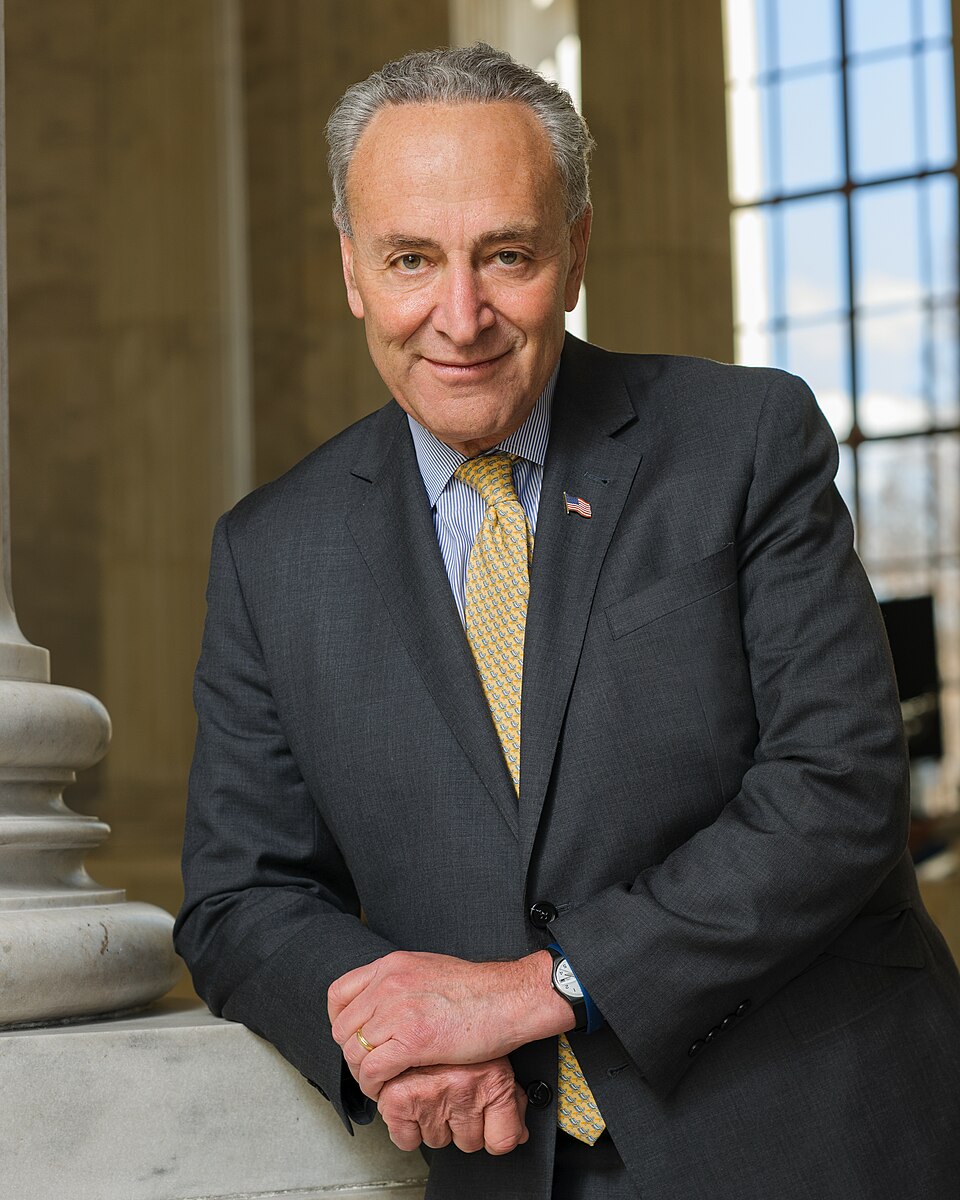
UAP research profile
Chuck Schumer
U.S. Senator and co-author of the UAP Disclosure Act
- TitleU.S. Senator and co-author of the UAP Disclosure Act
Overview
Charles E. "Chuck" Schumer is a United States Senator from New York and a central legislative figure in the modern UAP disclosure debate. His direct importance to the subject derives principally from his partnership with Senator Mike Rounds in introducing the Unidentified Anomalous Phenomena Disclosure Act of 2023, an unusually detailed proposal for government-wide identification, preservation, review and release of UAP-related records. [S1]
Schumer’s UAP initiative developed in the Senate in Washington, D.C. His July 2023 proposal with Rounds used the earlier federal review of President Kennedy’s assassination records as a model for identifying, preserving and releasing UAP-related government material. (Senate disclosure proposal, July 2023.)
Schumer's role centres on legislation and oversight. He has not presented himself as a UAP witness, nor does his sponsorship of legislation establish the factual existence of the categories defined within that legislation. The significance lies instead in the fact that a Senate Majority Leader placed UAP records, transparency and possible failures of congressional notification within a formal statutory framework.
Political background relevant to the UAP issue
Schumer was first elected to the U.S. Senate in 1998 and became leader of the Senate Democratic Caucus in 2016. He served as Senate Majority Leader from 2021 and has remained one of the most senior figures in the chamber. [S2]
His UAP legislative work also has a clear historical connection to former Senate Majority Leader Harry Reid. Schumer publicly described Reid as his mentor and close friend, and in announcing the 2023 legislation explicitly said he was carrying forward Reid's transparency legacy on the subject. [S1][S3]
That continuity matters because Reid had earlier used Senate appropriations and oversight channels to support the DIA programme known formally as the Advanced Aerospace Weapon System Applications Program (AAWSAP). Schumer's later intervention shifted the legislative emphasis away from sponsoring a research contract and towards records preservation, declassification procedures and congressional/public access.
The UAP Disclosure Act of 2023
On 14 July 2023, Schumer and Rounds announced the UAP Disclosure Act of 2023 as an amendment to the National Defense Authorization Act. The measure was co-sponsored with Senators Marco Rubio, Kirsten Gillibrand, Todd Young and Martin Heinrich. It was modelled explicitly on the President John F. Kennedy Assassination Records Collection Act of 1992. [S1]
The proposed architecture went substantially beyond a general call for transparency. It would have required a dedicated UAP Records Collection at the National Archives and Records Administration (NARA), a government-wide process for identifying relevant records, a presumption of immediate disclosure, and an independent review board empowered to assess postponements of release. [S1]
The proposal also contained definitions for "non-human intelligence" and "technologies of unknown origin" and contemplated federal eminent-domain authority over relevant recovered material. These provisions attracted considerable attention, but they require precise interpretation. A statutory definition establishes how a law would treat a category if relevant records or material exist; it does not itself demonstrate that the category is empirically real.
The Senate announcement was itself more cautious than some subsequent public discussion. It acknowledged that stories reaching Congress had "varying levels of credibility" and stated that the number and variety of accounts had led some members to suspect that important information might have been concealed. [S1] That is evidence of a serious congressional transparency concern. It is not public verification of the underlying allegations.
Schumer's stated rationale
Schumer framed the legislation around transparency, public trust and the need for an orderly disclosure mechanism. He argued that the public should be able to learn what the government knows about unexplained phenomena and that a durable pipeline was needed for future records and research. [S1]
A useful qualification comes from a separate 2023 interview in which Schumer said that he personally had not read the relevant report or received a briefing and described his underlying principle as one of disclosure rather than prior certainty about the outcome. He also contrasted his own view with Harry Reid's greater willingness to regard extraterrestrial intelligence as likely. [S4]
This distinction is important. Schumer's legislative conduct demonstrates that he considered the transparency and oversight problem serious enough to warrant major legislation. It does not show that he personally possessed or endorsed a particular classified explanation for UAP.
What survived the 2023 legislative process
The original Senate proposal did not survive intact in the final 2024 National Defense Authorization Act. In a Senate floor colloquy on 13 December 2023, Schumer and Rounds described the removal of key provisions during conference negotiations, particularly the independent review board and the proposed mechanism for government acquisition of relevant material. [S5]
Schumer nevertheless emphasised that the enacted measure still required the National Archives to establish a collection of UAP records and created a legal process for gathering relevant records across government. [S5] This surviving portion produced a tangible institutional result. NARA established Record Group 615, the Unidentified Anomalous Phenomena Records Collection. Under sections 1841–1843 of the FY2024 NDAA, federal agencies must review, identify and organise UAP records in their custody and transfer digital copies to the National Archives. [S6][S7]
As of September 2026, NARA's live Record Group 615 page lists material received from agencies including the Federal Aviation Administration, Nuclear Regulatory Commission, Office of the Director of National Intelligence, Office of the Secretary of Defense, National Security Agency, Department of State, Federal Bureau of Investigation and Department of the Air Force. NARA states that further material is being added on a rolling basis. [S6] This archival infrastructure is the clearest measurable legacy of Schumer's UAP legislative work to date.
Continued legislative effort
Schumer and Rounds continued to pursue the fuller disclosure architecture after the 2023 conference compromise. A 2024 Senate amendment again carried the title "Unidentified Anomalous Phenomena Disclosure Act of 2024" and repeated key concepts from the earlier proposal. The amendment was ordered to lie on the table rather than becoming the full disclosure framework envisioned by its sponsors. [S8]
The reintroduction is important evidence of persistence, but it should not be confused with enactment. Proposals, amendments approved by one chamber and enacted provisions represent different stages of the legislative process.
Evidence analysis
Schumer's significance can be measured without relying on claims about the underlying nature of UAP. Official Senate records establish that Schumer and Rounds led a detailed, bipartisan disclosure proposal. Portions of the legislation became law and led NARA to establish a dedicated UAP records collection. Schumer also publicly said that credible sources had alleged that information was being withheld from Congress, while preserving the conditional nature of that allegation. [S5]
A weaker inference arises when legislative language is treated as proof of the things it defines. Terms such as "non-human intelligence" and "technology of unknown origin" were written into a records-and-disclosure framework to ensure that potentially relevant material could not fall outside the law because of terminology. Their appearance demonstrates what categories Congress sought to capture; it does not establish that government possesses such material.
Similarly, the use of an eminent-domain mechanism in the original proposal shows that the drafters wanted legal authority capable of dealing with the possibility of privately held material. It does not demonstrate that any specified contractor possessed it.
What is established
- Schumer and Mike Rounds led the UAP Disclosure Act of 2023. [S1]
- The proposal was bipartisan and modelled on the JFK Assassination Records Collection Act. [S1]
- The original proposal included a dedicated records collection, presumption of disclosure, an independent review board and an eminent-domain mechanism. [S1]
- Key review-board and acquisition provisions were removed during the final 2023 NDAA negotiations. [S5]
- Surviving provisions became law and required NARA to establish a UAP records collection. [S6][S7]
- NARA has created Record Group 615 and is receiving records from multiple federal agencies on a rolling basis. [S6]
- Schumer explicitly linked his work to Harry Reid's earlier involvement with the subject. [S1]
What is not established
- The UAP Disclosure Act's definitions do not establish the existence of non-human intelligence or technologies of unknown origin.
- Schumer's statement that credible sources raised concerns about information being withheld does not publicly verify those underlying allegations.
Overall assessment
Schumer is significant to the UAP record because he transformed a subject often handled through hearings, intelligence reporting and individual testimony into a high-level records-management and disclosure problem. The original 2023 proposal was unusually specific: it anticipated a government-wide archive, an independent review mechanism, a strong presumption of disclosure and legal authority designed to recover potentially relevant material. That architecture reflected serious concern among its sponsors that existing classification and records processes might be inadequate.
The final law was narrower. Its most consequential surviving feature is Record Group 615, which has produced a permanent, centralised National Archives collection and a continuing obligation for agencies to identify and transfer UAP-related records. This is a concrete institutional outcome that can be evaluated independently of any position on what UAP ultimately represent.
Schumer's public language also warrants careful handling. He has supported broad legal definitions and has referred to credible allegations of withheld information, but he has also acknowledged that he did not personally begin this work from a position of certainty about extraordinary explanations. His contribution therefore lies not in possessing a publicly demonstrated answer to the UAP question, but in using senior legislative authority to create mechanisms through which the documentary record can be preserved and tested.
Confidence by proposition
| Proposition | Confidence | Basis |
|---|---|---|
| Schumer co-led the 2023 UAP Disclosure Act | High | Official Senate record |
| The original proposal included a review board and eminent-domain authority | High | Official legislative announcement/text |
| Parts of the proposal became law and created the basis for NARA Record Group 615 | High | NARA and statutory record |
| RG 615 is actively receiving UAP records from federal agencies | High | Current NARA collection page |
| Schumer was told by credible sources that information was improperly withheld | Moderate | Strong evidence he publicly reported this; underlying sources remain non-public |
| Legislative use of "non-human intelligence" confirms that such intelligence exists | Low | Definition is legal/conditional, not empirical evidence |
| The 2024 reintroduced full framework became law | Low | The amendment did not enact the complete framework |
Sources
[S1] Primary — U.S. Senate Democratic Caucus. "Schumer, Rounds Introduce New Legislation to Declassify Government Records Related to UAPs," 14 July 2023. https://www.democrats.senate.gov/newsroom/press-releases/schumer-rounds-introduce-new-legislation-to-declassify-government-records-related-to-unidentified-anomalous-phenomena-and-ufos_modeled-after-jfk-assassination-records-collection-act--as-an-amendment-to-ndaa
[S2] Primary — Office of Senator Chuck Schumer. Official biography. https://www.schumer.senate.gov/about/chuck
[S3] Primary — U.S. Senate Democratic Caucus. Schumer floor remarks on Harry Reid, 4 January 2022. https://www.democrats.senate.gov/newsroom/press-releases/majority-leader-schumer-floor-remarks-on-the-life-of-nevada-senator-harry-reid
[S4] Primary interview transcript — U.S. Senate Democratic Caucus. Transcript of Schumer interview discussing UAP legislation. https://www.democrats.senate.gov/newsroom/press-releases/transcript-majority-leader-schumer-talks-ira-and-democrats-economic-message-on-pod-save-america
[S5] Primary — U.S. Senate Democratic Caucus. Schumer–Rounds floor colloquy on UAP provisions, 13 December 2023. https://www.democrats.senate.gov/newsroom/press-releases/majority-leader-schumer-and-republican-senator-mike-rounds-floor-colloquy-on-unidentified-anomalous-phenomena-provisions-in-the-ndaa-and-future-legislation-on-uaps
[S6] Primary — U.S. National Archives and Records Administration. "Record Group 615: Unidentified Anomalous Phenomena Records Collection." https://www.archives.gov/research/topics/uaps/rg-615
[S7] Primary — U.S. National Archives and Records Administration. UAP Records Collection FAQ and statutory implementation background. https://www.archives.gov/research/topics/uaps/faqs
[S8] Primary — Congressional Record / U.S. Senate. UAP Disclosure Act of 2024 amendment (S. Amdt. 2610 to S. 4638), 11 July 2024. https://www.congress.gov/amendment/118th-congress/senate-amendment/2610