
UAP research profile
David Fravor
Retired U.S. Navy Commander | Principal firsthand witness in the 2004 Nimitz encounter
- TitleRetired U.S. Navy Commander
- Professional domainMilitary
- UAP roleFirsthand Witness · Military Witness
- NationalityUnited States
- Active period2004 event; public prominence from 2017
- OrganisationU.S. Navy
- Associated caseUSS Nimitz “Tic Tac” encounter
Retired Navy commander and visual witness to the November 2004 encounter commonly called the Nimitz “Tic Tac” incident.
Biography
David Fravor commanded Strike Fighter Squadron 41, the “Black Aces.” On November 14, 2004, his two-aircraft flight was redirected during a training exercise to investigate a contact reported by USS Princeton. His public account describes what he saw from his F/A-18F.
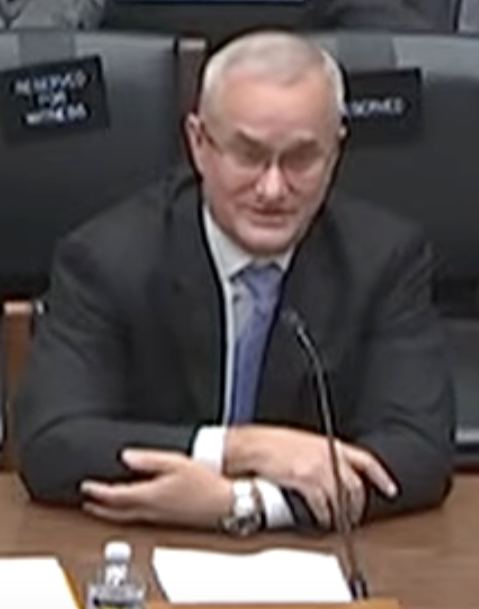
His aircraft operated from USS Nimitz and received directions from USS Princeton during the encounter. Fravor later presented the account at the Rayburn House Office Building in Washington, D.C., on 26 July 2023, bringing the Pacific training incident into a congressional hearing on military reporting and public safety. (Fravor: written testimony, July 2023; House Oversight: 26 July 2023 hearing venue; View the hearing and testimony.)
Fravor’s contribution is a named visual account from within the encounter. It can be compared with the other aircrew’s recollections, shipboard reports and a later infrared recording, while preserving the time and source of each observation.
Role in the UAP Topic
The encounter gained wider public attention in 2017. Fravor later appeared in interviews and, in July 2023, testified alongside Ryan Graves and David Grusch. His written submission describes the flight and his attempts to approach the object.
The public case contains several kinds of evidence. Fravor’s close visual account is one; radar operators’ descriptions and the later FLIR1 recording are others. Their relationship is a reconstruction problem, since the public material does not supply a continuous track joining them.
The scope of his observation
His account places him in the aircraft approaching the object, with another aircraft remaining above. He says his own radar did not show a contact on the approach. The earlier high-altitude tracks and the later report of a contact at the combat air patrol point came from the ship’s controller.
Those distinctions locate the source of the performance claims. A statement about what the controller reported is evidence of a communication to Fravor; it is not his direct measurement of that radar track. Written statement.
Reconstructing the encounter
Fravor describes movement he could not reconcile with the aircraft familiar to him. His flying experience helps explain the comparison he makes. Reconstructing a trajectory, however, also needs distances, viewing angles and timings with uncertainties attached. A remembered rapid departure is not itself a calibrated acceleration measurement.
The other pilot, Alex Dietrich, also reported seeing the object and disturbed water. Her account can help test the visual sequence from another position. Agreement about those features supports the report; an exact speed still requires enough geometry to distinguish object motion from changing perspective.
FLIR1 was recorded on a later sortie. The Pentagon’s April 2020 release establishes the video’s military provenance, but the clip does not depict Fravor’s close approach. Identifying its target as the same object requires a connection beyond their inclusion in the Nimitz narrative. Release statement.
Fravor’s interpretation that the object exceeded known capabilities remains part of his witness judgement. The public account contains no recovered material or complete sensor record establishing its origin. The detailed Nimitz case page follows the separate observations and the limits of their linkage.