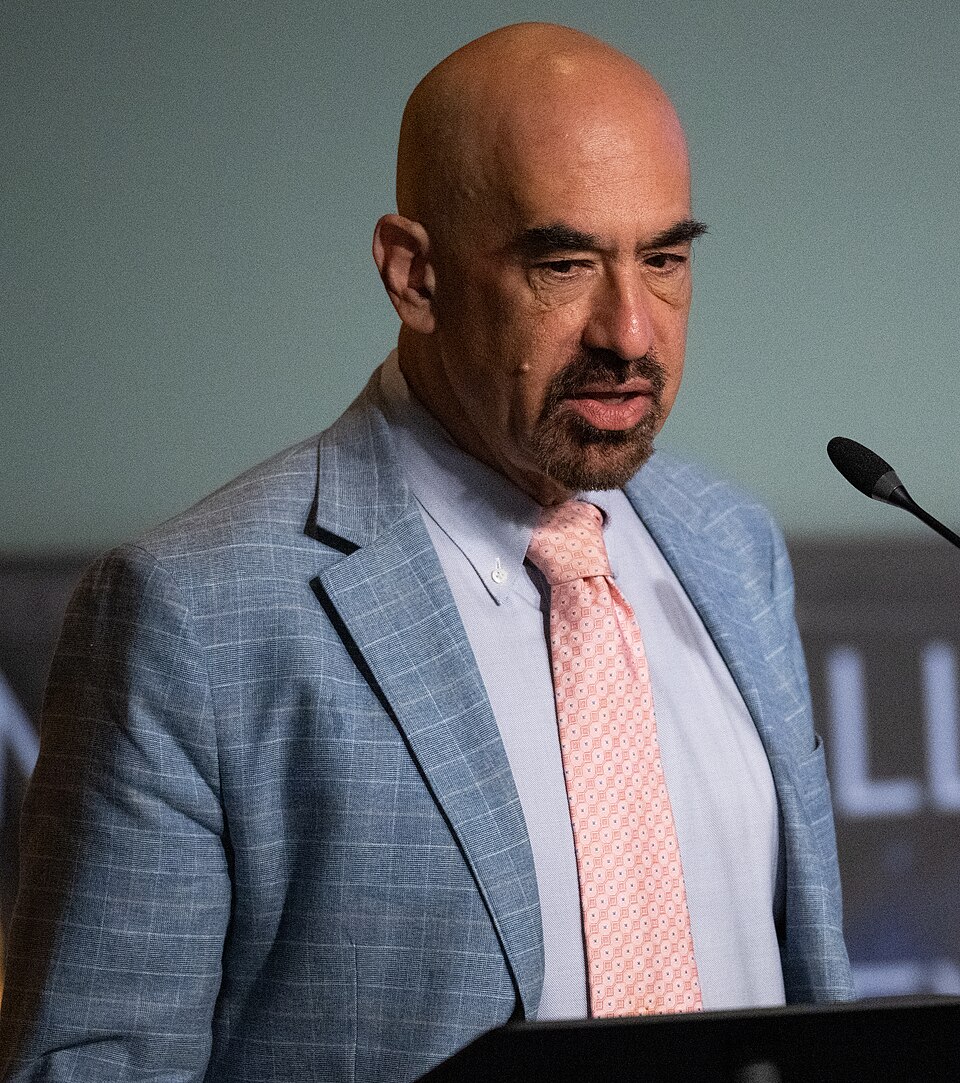
UAP research profile
David Spergel
Astrophysicist and chair of NASA's UAP Independent Study Team
- TitleAstrophysicist and chair of NASA's UAP Independent Study Team
Overview
David N. Spergel is an astrophysicist, President of the Simons Foundation and Professor Emeritus at Princeton University whose mainstream scientific career has centred on cosmology, cosmic microwave background analysis, exoplanets and major astronomical missions. In 2022 NASA selected him to chair its Independent Study Team on unidentified anomalous phenomena (UAP), a 16-member external group asked to determine how NASA's data, scientific methods and observational infrastructure could contribute to future UAP research. [S1][S2][S3]
Spergel’s professional work connects Princeton University in New Jersey with the Simons Foundation in New York. He became founding director of the Flatiron Institute’s Center for Computational Astrophysics in 2016 and foundation president in 2021. His NASA UAP study drew on this experience of organising collaborative scientific research. (Simons Foundation: Spergel biography; Simons Foundation: New York location.)
Spergel's importance to the UAP record is therefore methodological rather than testimonial. The NASA team was not commissioned to re-investigate famous historical UFO cases or determine whether any particular event had an extraterrestrial origin. NASA repeatedly stated that the study was designed to identify what data exist, what data should be collected in future and how scientific analysis could be improved. [S2][S3]
The team's 2023 final report concluded that the available UAP dataset contained too few high-quality observations for firm scientific conclusions about the nature of the phenomena. It recommended calibrated multisensor collection, robust metadata, systematic reporting, machine-learning analysis applied only to well-characterised datasets and greater use of NASA's scientific and aviation infrastructure. [S4][S5] Spergel is consequently one of the strongest examples of mainstream scientific engagement with UAP that neither dismisses the subject nor treats unresolved reports as evidence of a preferred extraordinary explanation.
Scientific career
Spergel earned his undergraduate degree at Princeton and his PhD in astronomy at Harvard. He joined the Princeton faculty in 1987, later chaired the Department of Astrophysical Sciences and became the Charles A. Young Professor of Astronomy. He is now Professor Emeritus. [S1][S6]
In 2016 he became founding director of the Center for Computational Astrophysics at the Flatiron Institute, and in 2021 he became President of the Simons Foundation. [S1][S6] His best-known work concerns the Wilkinson Microwave Anisotropy Probe (WMAP) and later cosmic-microwave-background measurements. Spergel and collaborators used those observations to constrain the age, geometry and composition of the universe and contributed substantially to the establishment of the standard cosmological model. [S1][S6] He also played major roles in the development of the Nancy Grace Roman Space Telescope science programme and has served on scientific advisory bodies including the National Academies' Space Studies Board and NASA-related committees. [S6]
This background is relevant because his scientific career is built on extracting physical conclusions from calibrated measurements, uncertainty estimates and large datasets. Those are precisely the areas in which NASA's UAP team concluded the existing evidence base was weakest.
NASA commissions a UAP study
NASA announced the UAP Independent Study in June 2022. The agency stated that the project would examine unidentified aerial phenomena from a scientific perspective using unclassified information. NASA also stated at the outset that there was no evidence UAP were extraterrestrial in origin. [S2]
In October 2022 NASA named the 16 team members and confirmed Spergel as chair. The membership included scientists, data specialists, aviation-safety experts, former astronaut Scott Kelly and representatives from commercial and government-related technical fields. [S3]
The study operated under Federal Advisory Committee Act procedures, and NASA's current FAQ states that members underwent ethics requirements and financial disclosure processes associated with their status. [S7] This matters because the team's institutional form was different from a private UFO research group. It was commissioned by NASA to give formal external scientific advice.
That still does not make every statement by an individual member a NASA conclusion. The final report represents the team's collective output.
Scope of the study
The team's scope is one of the most frequently misunderstood parts of NASA's UAP involvement. NASA explicitly stated that the study was not a review or assessment of previous UAP incidents. [S5] The team was instead asked eight methodological questions concerning:
- existing civilian and commercial datasets;
- data NASA might collect in future;
- analytical techniques;
- physical constraints;
- civil-airspace information;
- reporting protocols;
- air-traffic-management systems. This distinction is important.
The study did not conclude that famous cases such as Nimitz, GIMBAL, GOFAST or historical Blue Book events were extraordinary. It also did not conclude that those cases were all conventionally explained. They were simply outside the principal case-review mandate.
Data as the central problem
Spergel's public statements following the study consistently emphasised data quality. NASA's 2023 release quotes him saying that systematic calibration, multiple measurements and complete sensor metadata are required to build a reliable dataset for future study. [S5] The final report identifies several recurring weaknesses:
- poor or absent sensor calibration;
- lack of multiple independent measurements;
- missing sensor metadata;
- weak baseline data;
- incomplete curation;
- inconsistent civilian reporting. [S4]
These are not minor technical details. They determine whether a scientifically interesting quantity can be calculated.
For example, apparent rapid movement in a video does not establish extreme physical speed if range and camera geometry are unknown. An infrared signature may be difficult to interpret without knowing sensor response and processing. The team's central contribution was to move the question from "does this look unusual?" toward "what measurements are required to determine whether it is physically unusual?"
Calibration and metadata
The report gives unusually strong emphasis to calibration. A sensor records a physical world through an instrument with known and unknown behaviours. To interpret the result, researchers need information about:
- sensor type;
- operating mode;
- noise characteristics;
- time;
- location;
- pointing geometry;
- processing;
- calibration history. The report notes that apparent UAP have sometimes been shown to be sensor artefacts once calibration and metadata were examined. [S4]
This is not an argument that all UAP are artefacts. It establishes why an unexplained image is not yet sufficient evidence of an unusual external object. Spergel's team therefore treated instrument characterisation as part of the evidence rather than as secondary technical housekeeping.
Multiple measurements
The report also recommends detection through multiple well-calibrated sensors. Multisensor data can constrain different aspects of a target. Visible imagery may provide angular position. Infrared can provide spectral or thermal information.
Radar can provide range and velocity. Environmental data can test atmospheric explanations. The importance is not merely that "more sensors are better". Independent measurements can break degeneracies that make single-sensor observations impossible to interpret uniquely. This recommendation directly aligns with the measurement standards later emphasised by several contemporary UAP research groups.
Artificial intelligence and machine learning
The team recommended using artificial intelligence and machine learning to search large datasets for rare events. But the report included a critical condition: AI systems are useful only when trained and applied to well-characterised, rigorously collected data. [S4] This is important because algorithmic anomaly detection is often misunderstood. An AI model can identify a statistical outlier without determining why it is unusual.
Poor calibration, missing categories in training data or instrument noise can all produce outliers. NASA's report therefore connects AI to a broader scientific pipeline rather than treating it as an automated UFO detector.
Establishing the normal baseline
The final report argues that a search for anomalies requires a strong understanding of what is normal. Known aircraft, balloons, satellites, solar glints and atmospheric effects need to be measured with the same instruments under comparable conditions. Only then can researchers quantify how far a candidate observation deviates from the expected distribution. [S4] This is one of the report's most important methodological points.
A phenomenon is not scientifically anomalous merely because an observer is unfamiliar with it. An anomaly is meaningful only relative to a well-characterised background.
Citizen reporting and aviation safety
The NASA team also recommended improving civilian reporting. NASA already administers the Aviation Safety Reporting System (ASRS) for the FAA, a confidential voluntary reporting system used by pilots, air-traffic controllers and other aviation professionals. The panel suggested that NASA's experience could help build a more reliable UAP-reporting dataset and reduce stigma associated with reporting. [S4][S5] This does not imply that every pilot report is scientifically strong.
It addresses a data-quality problem: potentially useful observations cannot be analysed if they are not collected, and inconsistent reporting formats make later comparison difficult. The team's emphasis on stigma was therefore primarily methodological rather than social validation of extraordinary claims.
Physical constraints and extraordinary performance
The report considered whether existing observations allow physical constraints to be placed on UAP. Its answer was cautious.
The observations were too inconsistent to define one set of UAP characteristics. The report instead proposed comparing well-characterised observations against the known velocity and acceleration envelopes of aircraft, drones, balloons and other conventional systems. [S4]
A genuinely well-measured event outside those envelopes would be scientifically interesting. The crucial phrase is "well-measured". Claims of extreme acceleration are not strong merely because an object appears to cross a display quickly. Distance and geometry must be established. This point closely anticipates later debates over released military sensor videos.
What NASA did after the report
NASA released the final report on 14 September 2023 and announced the appointment of a Director of UAP Research. The agency said the director would coordinate NASA's contribution to the wider government effort, including data, artificial intelligence and scientific analysis. [S5] The decision demonstrates that the study produced an institutional consequence. NASA did not simply publish a one-off discussion paper.
It incorporated UAP research into an ongoing coordination function. The extent and output of that function should still be measured from subsequent work rather than inferred from the appointment alone.
Stigma and treatment of the study team
During the 2023 public meeting, NASA officials discussed harassment and stigma experienced by members of the study team. NASA's final recommendations emphasised that stigma can reduce reporting quality and discourage scientific participation. [S4][S5] This is relevant but must be interpreted carefully. Stigma can bias a dataset by causing under-reporting.
It is not evidence that the underlying extraordinary hypothesis is true. Likewise, harassment of researchers is inappropriate regardless of whether their eventual conclusions prove correct. A scientific culture needs to allow both investigation and criticism.
Evidence analysis
Spergel's UAP contribution has unusually strong source provenance. His appointment is documented by NASA. The team's mandate is public. The final report is public.
Its recommendations are explicit. The principal limitation is that the study was a methodology review rather than a case-resolution programme. This means Spergel should not be presented as a scientist who "investigated UFO evidence and found X". His team evaluated how NASA should investigate future UAP scientifically.
That narrower role is substantial enough. The report arguably became one of the clearest official statements of the data standards required before UAP can support strong scientific conclusions.
What is established
- Spergel is a highly accomplished astrophysicist with major contributions to modern cosmology. [S1][S6]
- NASA selected him to chair its UAP Independent Study Team. [S2][S3]
- The team consisted of 16 experts and worked under formal NASA/FACA procedures. [S3][S7]
- The study focused on scientific methodology and future data rather than re-investigating historical UAP cases. [S2][S5]
- The team concluded that existing high-quality observations were too limited for firm scientific conclusions about UAP nature. [S4][S5]
- It recommended calibrated multisensor collection, complete metadata, AI/ML applied to well-characterised data, better reporting and greater use of NASA capabilities. [S4][S5]
- NASA subsequently created a UAP research director role. [S5]
What is not established
- Spergel's study did not establish that UAP are extraterrestrial.
- It did not establish that every UAP has a conventional explanation.
Overall assessment
David Spergel chaired NASA's civilian scientific review of how UAP should be studied. The significance of the NASA report is not that it solved the phenomenon. It did something more foundational: it defined why the existing public evidence often cannot support the conclusions people attempt to draw from it. Calibration, metadata, range and independent measurement are not procedural details.
They are the difference between an unusual picture and a physically constrained observation. Spergel's own scientific career makes that emphasis especially appropriate. Modern precision cosmology became powerful because instruments, statistical inference and observational uncertainties improved enough to convert speculative questions into testable ones. The NASA UAP study implicitly sets a similar challenge.
If UAP research is to become mature science, it must generate observations designed for analysis rather than depend predominantly on accidental recordings from sensors built for other missions. Spergel therefore represents methodological restraint at a high institutional level. The team did not dismiss UAP and did not promote extraordinary interpretations. It established a roadmap by which extraordinary claims could eventually become testable.
Confidence by proposition
| Proposition | Confidence | Basis |
|---|---|---|
| Spergel is a leading mainstream astrophysicist | High | Princeton and Simons Foundation |
| He chaired NASA's UAP Independent Study Team | High | NASA official record |
| The study focused on future methodology, not historical case adjudication | High | NASA mandate and report |
| The team found current high-quality data insufficient for firm conclusions | High | NASA final report |
| The report recommends calibration, metadata and multisensor collection | High | Final report |
| NASA's study established extraterrestrial UAP | Low | It explicitly did not |
| Spergel's principal UAP contribution is methodological | High | Scope and output of study |
Sources
[S1] Primary institutional source — Simons Foundation. David Spergel biography. https://www.simonsfoundation.org/people/david-spergel/
[S2] Primary — NASA. "NASA to Discuss New Unidentified Aerial Phenomena Study Today," 9 June 2022. https://www.nasa.gov/news-release/nasa-to-discuss-new-unidentified-aerial-phenomena-study-today/
[S3] Primary — NASA. "NASA Announces Unidentified Aerial Phenomena Study Team Members," 21 October 2022. https://www.nasa.gov/general/nasa-announces-unidentified-aerial-phenomena-study-team-members/
[S4] Primary — NASA. Unidentified Anomalous Phenomena Independent Study Team Report, 14 September 2023. https://www.nasa.gov/wp-content/uploads/2023/09/uap-independent-study-team-final-report-0.pdf
[S5] Primary — NASA. "NASA Shares UAP Independent Study Report; Names Director," 14 September 2023. https://www.nasa.gov/news-release/update-nasa-shares-uap-independent-study-report-names-director/
[S6] Primary institutional source — Princeton University. David Spergel biography / emeritus research record. https://online.princeton.edu/people/david-spergel
[S7] Primary — NASA Science. UAP Independent Study FAQ and current programme archive. https://science.nasa.gov/uap/faqs/