UAP research profile
Donald E. Keyhoe
Former Marine aviator, author and NICAP director
- TitleFormer Marine aviator, author and NICAP director
Overview
Donald Edward Keyhoe (1897–1988) was a former U.S. Marine Corps aviator, aviation writer and long-serving director of the National Investigations Committee on Aerial Phenomena (NICAP). He became one of the most influential public figures in the first two decades of the modern flying-saucer/UFO era.
Keyhoe’s advocacy developed through NICAP in Washington, D.C., where a civilian organisation sought to collect sighting reports and press federal institutions for answers. The organisation’s location placed its research and lobbying close to the congressional and defence-policy bodies whose handling of UFO information he challenged. (Richard Hall: NICAP history.)
His significance rests on three related activities: popularising the argument that flying-saucer reports represented a serious phenomenon; building NICAP into a large civilian reporting and research organisation; and campaigning for greater congressional and government disclosure of UFO records. [S1][S2][S3] Keyhoe was also an early and committed advocate of the extraterrestrial interpretation. In The Flying Saucers Are Real (1950), he argued not only that the reports represented real machines but that the Air Force was concealing knowledge of their interplanetary origin. [S1]
He is historically important, but the support for his conclusions is difficult to assess. Keyhoe helped create pressure for transparency and more systematic civilian investigation, but his preferred explanation and secrecy thesis were often stronger than the public evidence available to establish them.
Aviation and writing background
Keyhoe graduated from the U.S. Naval Academy and served as a Marine Corps aviator. Biographical material associated with his aviation record also places him in early U.S. civil aviation and in promotional work connected with Charles Lindbergh. [S4][S5]
Before his UFO work, he was already an experienced aviation writer. This background influenced his later public authority. Keyhoe was not introduced to readers simply as a paranormal author; he presented himself as someone familiar with military aviation, government information and aeronautical development.
That experience gave him useful context for evaluating aircraft reports and military institutions. It did not supply direct knowledge of the origin of UFOs. The distinction between aviation expertise and access to extraordinary evidence is important throughout his career.
The 1949–1950 investigation
Keyhoe's major entry into the UFO debate came through True magazine and the subsequent 1950 book The Flying Saucers Are Real. The book is now available in a public-domain edition and provides direct access to his argument. Keyhoe described an investigation of Air Force reports and interviews with military contacts, concluding that the Air Force had become convinced the objects were interplanetary and was gradually preparing the public for disclosure. [S1]
This was not a cautious "unidentified" conclusion. Keyhoe explicitly developed a secrecy narrative. He interpreted changes in Air Force public statements, case reports and internal uncertainty as evidence that officials knew more than they admitted.
The book became highly influential in shaping early UFO culture. Smithsonian historical commentary identifies Keyhoe as one of the writers who helped establish the extraterrestrial interpretation for a large public audience in 1950. [S6]
The historical influence is clear. The conclusion about the underlying phenomena is much less secure.
The Air Force records available today establish that officials investigated UFO reports and debated possible explanations. They do not establish Keyhoe's 1950 conclusion that the government had already determined the objects were interplanetary spacecraft.
The extraterrestrial hypothesis
Keyhoe's early argument should be understood in its 1950 context. The modern UFO subject was only a few years old. The Air Force had operated Project Sign and Project Grudge, military concern about unidentified aircraft was real, and public understanding of rockets, atomic technology and spaceflight was changing rapidly.
Within this environment, Keyhoe interpreted reports from pilots and military personnel as evidence of advanced machines and then inferred non-terrestrial origin. The inference relied heavily on elimination: if the objects were not conventional aircraft, known U.S. systems, Soviet systems or simple errors, Keyhoe considered extraterrestrial technology the strongest explanation.
This is a recurring logical problem in UAP analysis. Eliminating some hypotheses does not automatically establish the remaining preferred hypothesis unless the full hypothesis space is known and the positive evidence supports it. Keyhoe's influence therefore illustrates both the power and risk of residual-case reasoning.
Creation of NICAP
NICAP was incorporated in Washington, D.C. in October 1956 by a group initially led by T. Townsend Brown. Contemporary and retrospective NICAP histories state that financial and organisational problems quickly emerged and that Keyhoe was installed as director in early 1957. [S2][S7]
This chronology matters because Keyhoe is sometimes described as NICAP's founder or co-founder. He was not the sole founder of the organisation. His historical importance lies in becoming the dominant director of its main operational period.
Under Keyhoe, NICAP developed a national network of members, investigators and scientific or technical advisers. A 1976 history by former NICAP figure Don Berliner describes the organisation as reaching a membership of roughly 14,000 in the late 1960s, maintaining a worldwide network of investigative subcommittees and advisers, publishing the UFO Investigator and producing special reports. [S2] These figures come from NICAP's own historical community and should be treated as organisational-history estimates rather than independently audited membership data. Nevertheless, the scale and influence of NICAP are well established.
NICAP's investigative model
NICAP attempted to create a civilian alternative to Air Force UFO investigation. Its model emphasised witness reporting, local investigators, aviation and military cases, technical advisers, case catalogues and pressure for official release of records.
The organisation's 1964 report The UFO Evidence, edited by Richard Hall, became one of its most important publications. It organised hundreds of cases into categories such as pilot reports, radar observations and physical effects. [S2]
Keyhoe's role was primarily executive, political and public-facing rather than authorship of every case analysis. This distinction is important because NICAP's strongest documentary products were collective works. They should not be attributed entirely to Keyhoe even though his leadership made the organisation possible. NICAP's data were also subject to the same limitations as other historical UFO collections: uneven report quality, self-selection, incomplete sensor information and varying investigative depth.
Government transparency and congressional pressure
Keyhoe's long-term political objective was to force greater disclosure of government UFO records and wider congressional investigation. FBI Vault records preserve correspondence between NICAP and the FBI between 1957 and 1969. One released document carries a NICAP membership appeal signed by Keyhoe describing the organisation's goal as ending government censorship and building a reporting network. [S8]
These records are useful because they independently confirm that NICAP was communicating with federal agencies rather than relying solely on its own later history. The existence of correspondence does not validate Keyhoe's claim that officials possessed proof of extraterrestrial spacecraft. It establishes that his transparency campaign was real and that government agencies recorded their interactions with NICAP.
NICAP also sought congressional attention and public hearings. This helped make government secrecy itself a central part of UFO politics long before the modern disclosure movement.
The 1958 television incident
On 22 January 1958, Keyhoe appeared on a live CBS Armstrong Circle Theatre broadcast about UFOs. During the programme, audio was cut after he departed from the approved script.
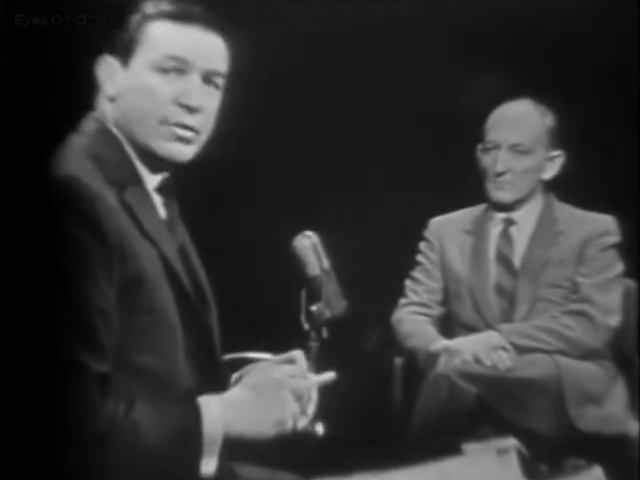
The incident quickly became part of UFO censorship history. A surviving March 1958 Mike Wallace interview with Keyhoe provides a valuable primary record of his account. Keyhoe said material had been removed from the programme script and argued that Air Force pressure amounted to censorship. [S9]
The event requires careful qualification. It is well established that the audio was cut when Keyhoe departed from the approved live script. It is also established that he later accused the Air Force of influencing what he had been allowed to say.
What is more difficult to establish is the full chain of responsibility and motive. Keyhoe himself had issued a statement acknowledging that CBS and the programme staff had rules concerning unapproved script changes. Later retellings often convert the event into a simple claim that "the government cut his microphone".
The more precise account is that CBS stopped an unscripted statement during a programme whose UFO content had been subject to prior approval and negotiation, while Keyhoe later alleged that Air Force pressure shaped those restrictions. That sequence is historically significant without requiring a stronger unsupported censorship claim.
High-level supporters and advisers
NICAP attracted several people with notable military, scientific or intelligence backgrounds. Former CIA Director Roscoe Hillenkoetter served on NICAP's board for a period, and other retired military figures were associated with the organisation. NICAP histories frequently cite this as evidence that Keyhoe's concerns were taken seriously by experienced officials. [S7]
Their participation is historically relevant. It does not establish that those individuals possessed classified proof of extraterrestrial craft or agreed with every Keyhoe claim. Board membership demonstrates support for investigation or transparency at minimum; the evidence supporting each individual's position must be examined separately.
Conflict with Air Force conclusions
Keyhoe's public career developed in sustained opposition to official Air Force statements that UFO reports did not demonstrate a threat or extraordinary craft. He interpreted changing programme names, unexplained cases and classified records as evidence of censorship. The Air Force, in turn, rejected his central conclusions. This conflict helped shape the public UFO debate into an adversarial structure: civilian investigators versus official explanations.
That structure had consequences. On the positive side, independent pressure can expose weak official reasoning and create incentives for record release.
On the negative side, once institutional denial is interpreted as evidence of concealment, almost any contrary statement can reinforce the original hypothesis rather than test it. This makes cover-up theories difficult to falsify. Keyhoe's later writing increasingly incorporated this secrecy framework.
NICAP decline and Keyhoe's departure
NICAP's fortunes declined sharply in the late 1960s. A history written by former NICAP personnel describes falling membership, financial pressure and internal organisational problems after the Condon Report period. The same source states that late-1969 restructuring removed Keyhoe from operational control. A 1970 UFO Investigator issue announced his retirement after 13 years as director. [S10][S11]
This part of the history should not be omitted from a substantive profile. Keyhoe was an effective public advocate and organisation-builder, but NICAP was not institutionally stable. Internal governance and financial difficulties contributed to the end of his directorship.
Later narratives sometimes attribute NICAP's decline principally to intelligence infiltration or external suppression. Questions about later leadership and intelligence connections deserve separate investigation, but the organisation's own histories also describe ordinary financial and management problems. The evidence does not support reducing NICAP's decline to one confirmed covert cause.
Legacy in the modern disclosure movement
Keyhoe's language and strategy anticipated several features of the modern UAP disclosure movement. He argued that:
- government records were being improperly withheld;
- pilots and military witnesses deserved greater attention to their accounts;
- civilian researchers should build independent case archives;
- Congress should investigate;
- public access to records was necessary to resolve disputes. These themes remain recognisable decades later.
The difference is that today's documentary environment is much richer. Large bodies of Blue Book, CIA, FBI, DIA, Navy, AARO and congressional records are publicly accessible, allowing some of Keyhoe's original claims to be tested in ways unavailable in 1950. That historical comparison allows his claims to be tested against subsequently released records.
Evidence analysis
Keyhoe's contribution has to be separated into influence, documentation and explanation. His influence is very strong. He helped move the flying-saucer issue into national media, wrote some of the earliest major books, directed NICAP during its most important period and made government transparency a central political question.
His organisational contribution is also strong. NICAP built a significant civilian reporting network and produced important case collections.
His explanatory conclusions are much weaker. In 1950 he moved rapidly from unexplained military reports to an interplanetary explanation and a government concealment hypothesis. His sources included genuine military cases and contacts, but the published evidence did not demonstrate the full conclusion.
This does not make his work historically irrelevant. It means that he should be studied both as a researcher and as an architect of the interpretive framework that later became part of UFO culture.
What is established
- Keyhoe was a former Marine aviator and established aviation writer before becoming prominent in UFO research. [S4][S5]
- His 1950 book explicitly argued that flying saucers were real and that the Air Force was concealing their interplanetary nature. [S1]
- NICAP was incorporated in 1956 and Keyhoe became its director in early 1957. [S2][S7]
- Under his leadership NICAP became a major civilian UFO organisation with a large reporting and membership network. [S2]
- NICAP communicated with federal agencies, including the FBI, and campaigned for disclosure. [S8]
- Keyhoe participated in the 1958 Armstrong Circle Theatre broadcast and later publicly alleged censorship pressure. [S9]
- He left operational leadership of NICAP around the end of 1969 after financial and organisational difficulties. [S10][S11]
What is not established
- Keyhoe's 1950 book does not establish that the Air Force had confirmed extraterrestrial spacecraft.
- Unidentified military sightings do not by themselves establish interplanetary origin.
Overall assessment
Donald Keyhoe was one of the principal architects of modern civilian UFO investigation and disclosure advocacy. He helped establish the idea that military and pilot reports deserved systematic attention, built NICAP into a substantial research and lobbying organisation and pressured federal agencies to release records. These are concrete historical contributions.
His work also demonstrates the need to test each step of an argument. Keyhoe frequently moved from a legitimate observation—that some reports remained unexplained and government information was incomplete—to a much stronger conclusion that extraterrestrial craft had been identified and concealed. The surviving public record does not establish that chain of inference.
His government-secrecy thesis became highly influential because it could explain both missing information and official denial. That made it politically powerful but scientifically difficult to falsify.
Keyhoe's legacy should therefore be neither celebrated uncritically nor reduced to early UFO mythology. He helped create civilian research infrastructure and transparency pressure that produced lasting historical value. At the same time, he illustrates how an investigator's preferred hypothesis can shape interpretation of ambiguous evidence.
His work provides a historical comparison with the current disclosure era. Many modern arguments about congressional oversight, pilot testimony, document release and institutional secrecy have clear precedents in Keyhoe's work more than sixty years earlier.
Confidence by proposition
| Proposition | Confidence | Basis |
|---|---|---|
| Keyhoe was a former Marine aviator and aviation writer | High | Aviation and biographical records |
| His 1950 work strongly advanced extraterrestrial and secrecy interpretations | High | His own book |
| He directed NICAP during its major 1957–1969 period | High | NICAP records and FBI correspondence |
| NICAP built a significant civilian case and reporting network | High | Organisational history and publications |
| The Air Force had already confirmed extraterrestrial craft as Keyhoe alleged | Low | No public primary record establishes his full conclusion |
| The 1958 audio cutoff proves direct government censorship | Low–Moderate | Cutoff is documented; motive/chain of authority remains contested |
| Keyhoe strongly influenced later UFO transparency/disclosure culture | High | Publications, NICAP activity and historical record |
Sources
[S1] Primary / first-person — Donald E. Keyhoe. The Flying Saucers Are Real, 1950. Public-domain text via Project Gutenberg. https://www.gutenberg.org/files/5883/5883-h/5883-h.htm
[S2] Organisational historical source — Don Berliner. "The National Investigations Committee on Aerial Phenomena," 1976, preserved by NICAP. https://www.nicap.org/articles/Nicap_history_1976.htm
[S3] Smithsonian Libraries and Archives. Bibliographic record for Keyhoe's UFO publications, demonstrating the scale and chronology of his published work. https://siris-libraries.si.edu/ipac20/ipac.jsp?aspect=subtab103&index=PAUTH&menu=search&profile=liball&ri=1&source=~%21silibraries&term=Keyhoe%2C+Donald+E.
[S4] Aviation-history source — Davis-Monthan Airfield Register. Donald Edward Keyhoe aviation biography drawing on Smithsonian biographical material. https://mail.dmairfield.org/people/keyhoe_de/index.html
[S5] Bibliographic/biographical source — Google Books. Flying With Lindbergh, author biography and early aviation career. https://books.google.com/books/about/Flying_With_Lindbergh.html?id=4gQqDwAAQBAJ
[S6] Smithsonian Magazine, Air & Space. Historical discussion of early public extraterrestrial interpretations and Keyhoe's role. https://www.smithsonianmag.com/air-space-magazine/ufos-uapswhatever-we-call-them-why-do-we-assume-mysterious-flying-objects-are-extraterrestrial-180978374/
[S7] Organisational historical account — Richard Hall. "The Real NICAP: 1957–1969," preserved by NICAP. https://www.nicap.org/papers/hall-IUR1994.htm
[S8] Primary federal archive — FBI Vault. Donald Keyhoe and NICAP files, including correspondence between NICAP and the FBI. https://vault.fbi.gov/search?SearchableText=Donald+Keyhoe
[S9] Primary interview archive — Harry Ransom Center. The Mike Wallace Interview with Major Donald E. Keyhoe, 8 March 1958. https://hrc.contentdm.oclc.org/digital/collection/p15878coll90/id/51/
[S10] Organisational history — Don Berliner / NICAP. Account of late-1960s membership, finances and Keyhoe leadership transition. https://www.nicap.org/articles/Nicap_history_1976.htm
[S11] Contemporary NICAP publication. UFO Investigator, May 1970, announcement of Keyhoe's retirement after 13 years as director. https://noufors.com/Documents/Books%2C%20Manuals%20and%20Published%20Papers/Specialty%20UFO%20Publications/NICAP%20UFO%20Investigator/050%20MAY%201970.pdf