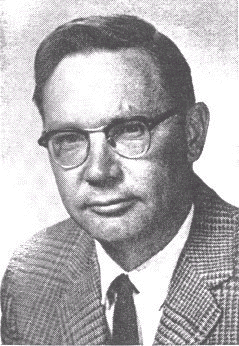
UAP research profile
James E. McDonald
Atmospheric physicist and scientific UFO investigator
- TitleAtmospheric physicist and scientific UFO investigator
Overview
James E. McDonald (1920–1971) was an atmospheric physicist at the University of Arizona who became one of the most prominent scientifically credentialled advocates for renewed investigation of UFO reports during the 1960s. His significance lies not merely in expressing an opinion that UFOs deserved attention, but in conducting extensive case research, examining Project Blue Book records, interviewing witnesses, presenting detailed arguments to Congress and professional scientific audiences, and challenging explanations that he considered physically inadequate. [S1][S2]
Tucson, Arizona, was McDonald’s academic and early UFO-investigation base. The University of Arizona records that he began collecting local sighting accounts before expanding his research and public advocacy. Its archive now preserves correspondence, recorded interviews and Blue Book material that allow that work to be traced beyond his published conclusions. (University of Arizona: McDonald archive.)
McDonald's scientific credentials were substantial. He held a PhD in physics, worked in cloud physics, weather modification and micrometeorology, and served as a professor at the University of Arizona's Institute of Atmospheric Physics. The university's archive describes him as internationally known in his field and preserves a large collection of UFO-related correspondence, case files, Project Blue Book copies, journals, recordings and research materials. [S1]
His UAP-related record requires a clear distinction between his documented research and his proposed explanation. McDonald argued that a small residue of reports could not be adequately explained and considered an extraterrestrial interpretation plausible. That was his scientific hypothesis, not a conclusion established by the government records or physical evidence available to him. His historical importance therefore lies in the seriousness of his challenge to prevailing investigative standards, the case material he preserved and re-examined, and the methodological debate his work generated.
Scientific background
The University of Arizona records that McDonald was born in 1920 and studied chemistry at the University of Omaha, meteorology at the Massachusetts Institute of Technology and physics at Iowa State College, where he earned his doctorate in 1951. He served in the U.S. Navy during the Second World War and later taught or conducted research at several institutions before joining the University of Arizona. [S1]
He became Associate Director of the Institute of Atmospheric Physics in 1954 and a professor from 1956 until his death in 1971. His conventional scientific work included cloud physics, weather modification and micrometeorology, and he published in atmospheric science independently of his UFO research. [S1]
This background is directly relevant to several UFO cases McDonald studied. Atmospheric propagation, anomalous radar returns, clouds, temperature inversions, optical effects and meteorological conditions were frequently proposed as explanations for unusual observations. McDonald therefore brought subject-matter expertise to at least part of the explanatory space rather than approaching the issue solely as a general enthusiast.
That expertise did not automatically make his conclusions correct. It did, however, make disagreements over atmospheric explanations scientifically substantive and capable of being examined on technical grounds.
Development of his UFO research
The University of Arizona's archive dates McDonald's sustained UFO investigations primarily from 1958 to 1971. His papers contain correspondence with government and military officials, other scientists and researchers; case files covering reports from the United States and abroad; photocopies of approximately 580 Project Blue Book sighting reports; four handwritten journals documenting investigative activity; more than 80 audio recordings; and extensive research material. [S1]
This archive is important because it shows that McDonald's engagement was not limited to public lectures. He built a research corpus, followed cases across jurisdictions and compared witness testimony with official explanations.
He increasingly concluded that a subset of reports deserved much more serious scientific attention than the Air Force or broader scientific community was giving them. The University of Arizona's collection description states that he considered an extraterrestrial information-gathering hypothesis plausible and believed official scientific reports such as the Condon Report were superficial or inadequate. [S1]
That institutional description should be read precisely. It documents McDonald's hypothesis and criticism; it does not establish that the hypothesis was correct.
Case-based method
McDonald's preferred method was intensive re-examination of cases that he considered difficult to reconcile with conventional explanations. He sought original witnesses, reconstructed geometries, checked weather information, compared radar and visual accounts and searched government files for material omitted from secondary retellings. His congressional statement in 1968 presented a long series of selected cases that he believed illustrated weaknesses in Air Force explanations and the need for further study. [S2]
This method had a clear strength: it moved beyond general argument and allowed specific explanations to be tested against details of specific events. It also carried an important risk. A researcher who selects cases because they appear difficult can build a corpus that is deliberately unrepresentative of the total reporting population. That is appropriate if the research question is "are there any reports that remain technically puzzling?", but it cannot by itself establish the prevalence or overall nature of UFO reports.
McDonald's strongest work is therefore best evaluated case by case. The fact that he successfully exposed a weakness in one official explanation does not validate every other case or his preferred overarching hypothesis.
The 1968 House symposium
On 29 July 1968, the U.S. House Committee on Science and Astronautics held a symposium on unidentified flying objects. The official GovInfo record identifies it as a hearing of the 90th Congress and preserves the full committee material. [S2]
McDonald appeared as Senior Physicist at the Institute of Atmospheric Physics and professor in the University of Arizona Department of Meteorology. His prepared statement presented a large number of cases, discussed the limitations of Project Blue Book and argued that the subject had not received adequate scientific investigation. [S2][S3]
The symposium itself should not be misrepresented as a congressional finding that UFOs were extraordinary. Committee chairman J. Edward Roush framed the event as a scientific inquiry into unanswered questions, not as a proceeding with a predetermined conclusion. Other participants held different views, including Carl Sagan and scientists who were more cautious about extraordinary interpretations. [S2]
McDonald's testimony is important because it placed detailed scientific criticism of official UFO investigation into the formal congressional record. Its evidential weight, however, remains the weight of a scientist's analysis and selected case presentations, not a committee endorsement of his conclusions.
Criticism of Project Blue Book
McDonald argued that Project Blue Book's unresolved cases had been too readily dismissed or assigned weak conventional explanations. His criticism was partly institutional and partly technical. Institutionally, he believed the programme lacked sufficient scientific depth and had become oriented toward public explanation rather than open-ended investigation. Technically, he challenged particular uses of weather, astronomical or radar-propagation explanations where he believed the physical conditions did not match the proposed mechanism. [S2][S4]
This critique overlapped with wider professional concern during the period. The American Institute of Aeronautics and Astronautics' UFO Subcommittee later concluded that it was difficult to ignore a small residue of well-documented unexplained cases and recommended continued moderate-level work with improved data collection and high-quality analysis. [S5]
That AIAA position was not equivalent to McDonald's extraterrestrial hypothesis. It is useful precisely because it shows that one could agree with part of McDonald's methodological criticism without accepting his stronger interpretation.
The Condon Report
The University of Colorado UFO project, directed by physicist Edward Condon and funded by the U.S. Air Force, produced its final report in 1968–69. Condon's summary argued that further extensive study was unlikely to advance science. The report contributed to the Air Force's later termination of Project Blue Book. [S6]
McDonald became one of the most prominent scientific critics of the Colorado study. He argued that case material within the report did not support such a broad dismissal and criticised specific case analyses, particularly where he believed atmospheric or radar explanations were physically inadequate. [S1][S4]
His criticism should be separated into two propositions. The first is methodological: whether the Condon Report's overall conclusion was proportionate to the unresolved material within its own case studies. This was also questioned by the AIAA UFO Subcommittee, which argued that the report's content could support continued scientific curiosity even if it did not establish an extraordinary phenomenon. [S5]
The second is explanatory: whether the unresolved cases support an extraterrestrial interpretation. That does not follow automatically from criticism of the Condon Report. Demonstrating that one proposed conventional explanation is insufficient leaves the case unresolved unless positive evidence supports another hypothesis. McDonald sometimes moved further toward the second proposition than later scientific bodies were willing to go.
Radar meteorology and technical argument
McDonald's 1970 paper "Meteorological Factors in Unidentified Radar Returns", presented at the 14th Radar Meteorology Conference of the American Meteorological Society, is especially important because it placed part of the UFO debate into his own technical discipline. [S4][S7] The paper reviewed classes of radar returns caused by known atmospheric mechanisms and distinguished them from a residual class of reports involving localised, apparently fast-moving targets that he believed had too readily been attributed to anomalous propagation.
His argument was not that radar returns automatically represented craft. It was that "anomalous propagation" had sometimes been used as a generic explanation without sufficient demonstration that the required atmospheric conditions existed.
This is a scientifically useful distinction. Radar can generate artefacts, ducting, biological returns, propagation anomalies and false targets. An apparently anomalous radar track therefore requires careful instrument and atmosphere analysis. But the mere availability of such mechanisms does not mean that any one mechanism explains a specific event.
McDonald's paper is strongest where it forces a case-specific physical test. It is weakest if the failure of one atmospheric explanation is treated as positive evidence for an extraterrestrial device.
The RB-47 case and AIAA publication
McDonald also re-examined the 17 July 1957 RB-47 incident, in which an Air Force reconnaissance aircraft crew reported visual and electronic observations of an unidentified phenomenon. The AIAA UFO Subcommittee published McDonald's analysis in Astronautics & Aeronautics in July 1971 as "UFO Encounter I". The editorial introduction noted that the Condon project had initially been unable to locate the correct case file and had used an incorrect date in some radar and weather analysis. McDonald subsequently located relevant files, corrected the date and obtained additional information from crew interviews. [S8]
This episode is important because it demonstrates a concrete contribution beyond advocacy: McDonald identified documentary and chronological problems in an earlier analysis. It also illustrates the limitations of historical case work. Even with improved records, the event was already years old. Some relevant instrumentation was unavailable and evaluation depended partly on witness recollection. The AIAA presented the case so members could assess the difficulty rather than declaring that McDonald had proved a specific extraordinary origin. [S8]
"Science in Default"
McDonald's broader critique was encapsulated in his paper commonly known as "Science in Default", developed from material presented to the American Association for the Advancement of Science at its 1969 meeting and later published in UFO's—A Scientific Debate. [S9] His central argument was that the scientific community had largely failed to study the problem on the merits of the evidence, partly because of stigma, institutional assumptions and reliance on inadequate official reviews. This argument has continuing historical importance because similar concerns about stigma and data quality resurfaced decades later in modern UAP discussions.
However, the existence of stigma does not itself validate the underlying claim. A subject can be socially neglected and still be explained by conventional mechanisms; equally, institutional dismissal can make it harder to discover whether a genuine anomaly exists. The appropriate response is better data and analysis rather than inference from stigma.
Relationship to the extraterrestrial hypothesis
McDonald increasingly regarded an extraterrestrial hypothesis as the most plausible broad explanation for the strongest cases he studied. The University of Arizona archive explicitly records this position. [S1]
Scientific reputation and the evidence for a particular explanation are separate questions. McDonald's scientific standing made his judgement historically significant. It did not transform the extraterrestrial hypothesis into an established scientific conclusion. The evidence available to him consisted principally of witness reports, government files, radar accounts, photographs and case reconstructions. He did not present publicly accessible recovered technology, biological evidence or a reproducible experimental phenomenon.
His conclusion was therefore an inference from a case corpus, not direct confirmation of origin.
Evidence analysis
McDonald's contribution has three distinct strengths. First, he created and preserved a substantial research archive. The University of Arizona collection demonstrates the scale of his correspondence, case work and acquisition of Project Blue Book material. This is a documentary contribution independent of whether his conclusions were correct. [S1]
Second, he repeatedly tested official explanations rather than merely rejecting them. His radar work and RB-47 analysis show specific attempts to compare proposed mechanisms against meteorology, chronology and original files. [S4][S8]
Third, he forced the subject into scientific and congressional forums where disagreement could be documented publicly. [S2][S9] The limitations are equally important.
His research often concentrated on selected difficult cases rather than a representative population. Many cases were historical by the time he investigated them and lacked calibrated instrument data. Witness memory, incomplete archives and uncertain geometry remained major constraints.
There is also a risk of confirmation bias once a researcher adopts a preferred hypothesis. McDonald's growing support for an extraterrestrial interpretation means his later work should be examined for whether competing hypotheses were assessed against the evidence on equal terms. That is not a reason to dismiss the work; it is a normal requirement of scientific evaluation.
What is established
- McDonald was a University of Arizona atmospheric physicist with recognised conventional scientific credentials. [S1]
- He conducted sustained UFO research from the late 1950s until 1971. [S1]
- His archive contains extensive correspondence, case files, approximately 580 copied Project Blue Book reports and more than 80 audio recordings. [S1]
- He presented detailed UFO analysis to the House Committee on Science and Astronautics in 1968. [S2]
- He publicly criticised Project Blue Book and the Condon Report on methodological and case-specific grounds. [S2][S4]
- He presented a radar-meteorology paper at an American Meteorological Society conference in 1970. [S4][S7]
- His re-investigation of the 1957 RB-47 case identified documentary/date problems in the Condon project's treatment and was published by the AIAA. [S8]
- He considered an extraterrestrial hypothesis plausible and increasingly favoured it for the strongest cases. [S1]
What is not established
- McDonald's scientific credentials do not establish that his preferred extraterrestrial hypothesis was correct.
- Demonstrating that an official explanation was weak does not establish a specific alternative explanation.
Overall assessment
James E. McDonald is historically significant because he represented one of the strongest attempts in the 1960s to challenge the scientific adequacy of official UFO investigation from within a relevant physical-science discipline.
His contribution was not simply that he believed some reports were extraordinary. He built a research archive, revisited witnesses, examined government case files, tested atmospheric explanations and presented detailed material to Congress and scientific organisations. In specific cases, such as the RB-47 incident, his work exposed concrete errors or omissions in earlier analysis.
At the same time, the strongest conclusion he drew from the corpus—that an extraterrestrial interpretation best explained the residual cases—was not established by direct physical evidence. His scientific credentials give that judgement historical weight, but not automatic validity.
McDonald's work is most useful when treated as a methodological challenge. He demonstrated that weak official explanations should not be accepted simply because they are conventional, and that an unresolved observation should remain unresolved when the data do not support identification. The same standard applies to extraordinary interpretations.
His long-term significance is therefore twofold. He preserved and improved access to an important historical case record, and he articulated a criticism that remains relevant to modern UAP research: the quality of the conclusion cannot exceed the quality of the data. Where the data are incomplete, scientific honesty may require neither dismissal nor extraordinary attribution, but continued uncertainty.
Confidence by proposition
| Proposition | Confidence | Basis |
|---|---|---|
| McDonald was a credentialled atmospheric physicist at the University of Arizona | High | University archive |
| He conducted extensive case and archive research on UFOs | High | University archive and published work |
| He testified/presented at the 1968 House UFO symposium | High | Official GovInfo hearing record |
| He identified real analytical/documentary problems in some prior case treatments | High for specific cases | AIAA publication and radar work |
| His preferred extraterrestrial hypothesis was scientifically established | Low | Inference from unresolved cases; no direct confirming evidence |
| Every case he regarded as unexplained remains unexplained under later analysis | Low–Moderate | Must be assessed case by case |
| His broader criticism that official study sometimes suffered from data/method problems | Moderate–High | Supported by specific examples and later AIAA concern |
Sources
[S1] Primary institutional archive — University of Arizona Libraries, Special Collections. "James E. McDonald papers," MS 412. https://lib.arizona.edu/special-collections/collections/james-e-mcdonald-papers
[S2] Primary — U.S. Government Publishing Office / House Committee on Science and Astronautics. Symposium on Unidentified Flying Objects, 29 July 1968, 90th Congress. https://www.govinfo.gov/app/details/CHRG-90hhrg97818/CHRG-90hhrg97818
[S3] Primary statement — James E. McDonald. "Statement on Unidentified Flying Objects," submitted to the House symposium, 29 July 1968. Archival PDF copy. https://commons.wikimedia.org/wiki/File:Statement_on_Unidentified_Flying_Objects_by_James_E._McDonald.pdf
[S4] Primary technical paper — James E. McDonald. "Meteorological Factors in Unidentified Radar Returns," 14th Radar Meteorology Conference, American Meteorological Society, 17–20 November 1970. https://www.project1947.com/shg/articles/metfac70.html
[S5] Professional-body record — American Institute of Aeronautics and Astronautics UFO Subcommittee. "UFO: An Appraisal of the Problem," Astronautics & Aeronautics, November 1970. Bibliographic summary preserved in the Congressional Research Service report The UFO Enigma. https://digital.library.unt.edu/ark:/67531/metadc993849/m2/1/high_res_d/76-52SP_1976march9.pdf
[S6] Primary commissioned study — University of Colorado / U.S. Air Force. Scientific Study of Unidentified Flying Objects (Condon Report), 1968–69. NCAS archival transcription, including the summary and conclusions. https://condon.ncas.org/text/contents.htm
[S7] Bibliographic record — American Meteorological Society. Preprints, 14th Radar Meteorology Conference (1970), listing McDonald's paper. https://books.google.com/books/about/Preprints_Radar_Meteorology_Conference.html?id=dMARAQAAIAAJ
[S8] Professional publication — AIAA UFO Subcommittee / James E. McDonald. "UFO Encounter I: Sample Case Selected by the UFO Subcommittee of the AIAA," Astronautics & Aeronautics, July 1971. https://www.nicap.org/papers/AIAA_rep1.pdf
[S9] Scientific symposium volume — Carl Sagan and Thornton Page, eds. UFO's—A Scientific Debate, Cornell University Press, 1972, containing material arising from the 1969 AAAS symposium including McDonald's "Science in Default". https://books.google.com/books/about/UFO_s_a_Scientific_Debate.html?id=Z5pTAAAAMAAJ