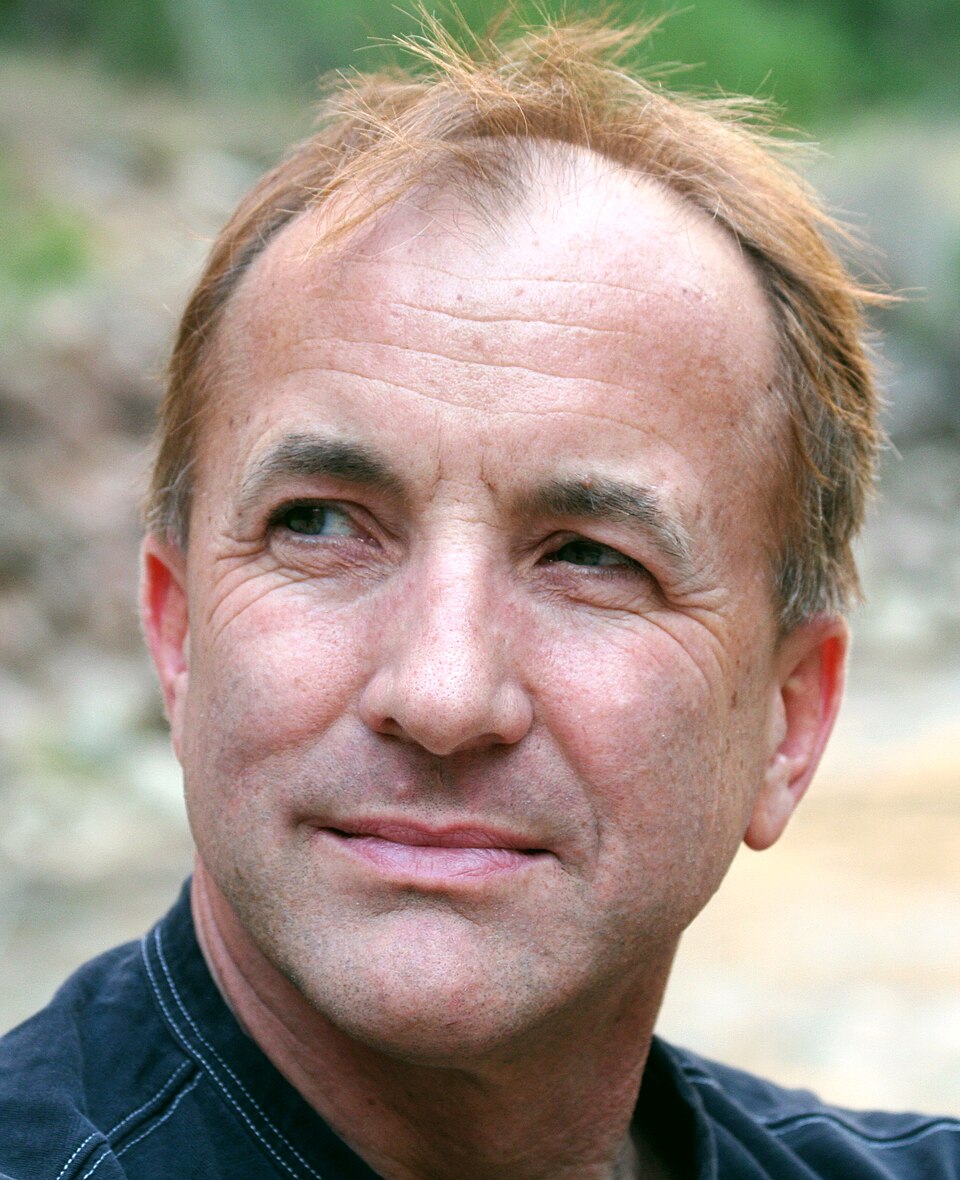
David Patton · CC BY 3.0 · Resized for web use and displayed with a circular CSS crop
UAP research profile
Michael Shermer
Science writer, historian of science and UAPSAC sceptical adviser
- TitleScience writer, historian of science and UAPSAC sceptical adviser
Overview
Michael Shermer is a science writer, historian of science and long-running advocate of scientific skepticism. He co-founded the Skeptics Society and Skeptic magazine in 1992 and has spent more than three decades examining claims involving pseudoscience, paranormal phenomena, conspiracy theories, religion and UFOs. He holds an MA in experimental psychology and a PhD in the history of science. [S1][S2]
Shermer’s professional contact page and the Skeptics Society’s mailing address identify Santa Barbara, California, as a correspondence locality. His publishing, lectures and educational work connect that organisational setting with an international audience for scientific scepticism. (Shermer: professional contact; Skeptics Society: correspondence address.)
In June 2026, Shermer was named to the UAP Science Advisory Council (UAPSAC), with the "study of anomalies" identified as his area. His inclusion is significant precisely because he has been one of the most publicly sceptical participants in contemporary UAP discussion. [S3][S4]
Shermer does not approach the council from a position that UAP have been demonstrated to represent non-human technology. His public writing repeatedly argues that testimony, unresolved imagery and secrecy allegations have not yet met the evidential threshold required for that conclusion. [S5][S6]
His contribution is methodological diversity. A scientific advisory group dealing with ambiguous and culturally charged evidence benefits from members whose role includes trying to falsify preferred explanations, identifying cognitive traps and demanding discriminating evidence.
That does not make scepticism infallible. A sceptical prior can itself become a source of bias if conventional explanations are accepted at a lower standard of evidence than extraordinary ones.
Academic and professional background
Shermer's biography records a BA in psychology from Pepperdine University, an MA in experimental psychology from California State University, Fullerton, and a PhD in the history of science from Claremont Graduate University. [S1] He taught university and college courses for decades and has written extensively about belief formation, conspiracy theories, scientific reasoning and the history of science.
He co-founded the Skeptics Society and Skeptic magazine in 1992. The organisation describes its mission as promoting science, reason and critical analysis of complex claims. [S2]
For 18 years Shermer wrote a monthly column for Scientific American, and his books include Why People Believe Weird Things, The Believing Brain, Conspiracy and Truth. [S1] This background is relevant to UAP because the subject combines uncertain physical observations with testimony, secrecy, social identity, institutional distrust and belief formation. Shermer's expertise is therefore strongest in reasoning, science history and public claims—not in radar engineering or aerospace sensor calibration.
Scientific skepticism as method
Scientific skepticism is often misunderstood as disbelief. In its stronger form, it is a method of withholding or calibrating belief according to the quality of evidence and attempting to disconfirm favoured hypotheses. Shermer's 2026 writing on truth emphasises fallibilism, objectivity, disconfirmation and accountability. [S7]
Applied to UAP, this means asking:
- What observation would distinguish the proposed explanation from alternatives?
- What would falsify the claim?
- Are witnesses independent?
- Does a case rely on circular sourcing?
- Are physical quantities measured or inferred?
- Does the explanation predict anything not already used to construct it?
These questions are useful regardless of whether the final answer is conventional or extraordinary.
Long-running engagement with UFO claims
Shermer and the Skeptics Society have addressed UFO and alien claims since the organisation's early years. In a 2026 retrospective, Shermer explicitly included UFOs and aliens among the anomalous claims that motivated the creation of Skeptic. [S8] His broad position has been that extraterrestrial life is plausible or likely somewhere in the universe while evidence that extraterrestrial beings are visiting Earth remains insufficient. This distinction is scientifically important.
The prior probability that life exists elsewhere is not the same question as whether a specific aerial report represents extraterrestrial technology. SETI, astrobiology and UAP claims require different kinds of evidence.
Response to The Age of Disclosure
Shermer's 2025 review of The Age of Disclosure provides a clear statement of his modern UAP position. He acknowledged the unusual status of some witnesses and officials but argued that the documentary's claims about alien technology and secret retrieval programmes were not accompanied by publicly inspectable evidence sufficient to establish them. [S5] His standard of evidence was intentionally high. He has used examples such as a physical craft, body or otherwise independently testable material as the kind of evidence that would transform the debate.
Critics argued that this standard risked becoming too restrictive, particularly if the phenomenon or alleged programmes are not accessible in a way convenient for open science. Shermer responded by addressing the falsifiability question directly and maintaining that claims must remain testable rather than protected indefinitely by secrecy arguments. [S6] This exchange exposes a real epistemological problem rather than a simple believer-versus-sceptic divide.
Falsifiability and secrecy
Crash-retrieval allegations create a difficult structure for evidence assessment. Supporters may argue that proof exists but is classified. A sceptic may respond that absent public evidence, the claim should not be accepted. Both statements can be logically consistent.
The problem arises when classification becomes a universal explanation for every gap in the evidence. If no possible public result could count against the hypothesis, the claim becomes difficult to falsify.
Shermer's contribution is to insist that a scientific proposition needs conditions under which researchers would change their minds. The same standard should apply to scepticism. A sceptic should identify what evidence would cause acceptance of an extraordinary explanation rather than simply raising the threshold each time new evidence appears. Shermer has attempted to state such thresholds, which makes his position more scientifically useful than categorical dismissal.
Review of the 2026 UAP file releases
Following the May 2026 government UAP file release, Shermer published a strongly sceptical assessment arguing that the material he had reviewed did not contain the type of evidence needed to establish alien visitation. [S9] This is an attributable interpretation, not a complete independent audit of every government holding. It is important not to invert the same authority problem often present on the pro-disclosure side. Shermer's long experience with extraordinary claims does not make his reading of a video or document automatically correct.
The underlying records should remain primary. His analysis is most valuable when it identifies specific weaknesses in the evidence: poor imagery, ambiguous testimony, lack of provenance, missing range or unsupported inference.
Galileo Project involvement
Shermer has also participated in Avi Loeb's Galileo Project. In July 2026, writing as a UAPSAC member, he stated that he had been a member of the Galileo Project for five years. [S10] This is relevant because it shows that his role is not limited to external media criticism. The Galileo Project seeks prospective instrumental evidence using multimodal observatories designed to classify known objects and identify statistical outliers.
Shermer's participation does not mean that he designed the instrumentation or authored the project's technical papers. His value is more plausibly adversarial review and anomaly interpretation. Membership does not establish technical authorship.
Joining UAPSAC
On 15 June 2026, the Skeptics Society announced Shermer's appointment to UAPSAC. The public council roster described his role as the study of anomalies. [S3]
DefenseScoop subsequently reported the council's connection to the ODNI-supported UAP Governance Board and independently listed Shermer among its members. [S4] Shermer said he viewed the appointment as an opportunity to investigate anomalies with curiosity, scepticism and methodological rigour. [S3] His inclusion is strategically significant because multidisciplinary councils are vulnerable to groupthink. A council composed only of people already convinced that UAP represent non-human technology would face a substantial confirmation-bias risk. An explicit sceptical participant can improve reasoning if disagreement is genuine and consequential.
Alternative hypotheses and natural explanations
Shermer continues to investigate conventional or natural hypotheses for UAP. In July 2026, he discussed a proposed atmospheric explanation for historical luminous "foo fighter" or orb reports involving magnetically confined dusty plasmoids. [S10] The value of considering such hypotheses is not that one natural model should be accepted because it is conventional. It is that UAP research requires a competitive hypothesis set.
A proposed plasma explanation should make physical predictions and be compared against observation in exactly the same way as a technological hypothesis. If it does not explain duration, motion, spectra or other data, it should be rejected or modified. Scientific scepticism is strongest when it produces testable alternatives rather than generic appeals to misidentification.
Potential weaknesses of sceptical analysis
Scepticism has characteristic failure modes. One is asymmetrical standards. If an extraordinary explanation must meet a very high standard of evidence but a conventional explanation is accepted merely because it is possible, the analysis is not neutral. A bird, balloon, plasma, drone or optical artefact should be demonstrated from the data where possible, not invoked as a verbal escape route.
Another weakness is overreliance on historical base rates. Most UFO reports may have conventional explanations while an individual case could still be unusual. A high conventional base rate reduces prior probability but does not resolve a specific well-characterised observation. A third risk is social dismissal.
If sceptical rhetoric implies that only irrational people investigate UAP, it can increase reporting stigma and reduce the quality of the dataset. Shermer's UAPSAC role is therefore most useful if scepticism functions as methodological red-teaming rather than identity-based opposition.
Evidence analysis
Shermer's main UAP contribution is to the criteria used to evaluate claims. He has not publicly produced a sensor dataset that resolves a major UAP case. This can be substantial in a field where testimony and institutional authority frequently substitute for direct evidence.
His long history of examining anomalous claims gives him experience with confirmation bias, narrative reinforcement and unfalsifiable explanations. The limitation is that a sceptical framework can itself become rigid. The appropriate test is whether Shermer applies the same demand for positive evidence to conventional explanations and remains willing to update when genuinely discriminating data appear.
What is established
- Shermer has formal training in psychology and history of science and a long public career in scientific skepticism. [S1][S2]
- He co-founded the Skeptics Society and Skeptic magazine in 1992. [S2]
- He has written extensively about UFOs, aliens, belief formation and extraordinary claims. [S5][S8][S9]
- He is a member of UAPSAC, publicly assigned to the study of anomalies. [S3][S4]
- He reports having participated in the Galileo Project for several years. [S10]
- His current public position is that the evidence for alien visitation or recovered non-human technology remains insufficient. [S5][S6]
- He has publicly articulated falsifiability and evidential thresholds rather than simply saying the subject should not be studied. [S6][S7]
What is not established
- Shermer's scepticism does not establish that every unresolved UAP has a conventional explanation.
- His history-of-science and psychology background does not make him an aerospace sensor specialist.
Overall assessment
Shermer's criticism is valuable where it improves falsifiability, identifies hidden assumptions and prevents authority or testimony from being mistaken for measurement.
Shermer's strongest argument is that a claim of non-human technology requires positive, discriminating evidence. The fact that a report remains unresolved is not enough.
That standard is consistent with UAPRAD's evidence-first approach. The same discipline should be applied to Shermer's own conventional interpretations. A sceptical explanation should not win simply because it is familiar; it should explain the evidence. The most productive role for Shermer on UAPSAC is therefore not to represent a predetermined "no", but to act as an adversarial test of inference while remaining open to evidence that survives those tests. His historical significance will ultimately depend on whether the council produces transparent analyses in which disagreement leads to stronger methods rather than rhetorical camps.
Confidence by proposition
| Proposition | Confidence | Basis |
|---|---|---|
| Shermer has a long professional record in scientific skepticism | High | Skeptics Society and personal biography |
| He has relevant formal training in psychology/history of science | High | Degree record |
| He is a UAPSAC member focused on anomalies | High | Council announcement and DefenseScoop |
| He remains sceptical that public UAP evidence establishes alien visitation | High | Recent first-person writing |
| His scepticism proves UAP have conventional origins | Low | Methodological position is not case evidence |
| He has participated in the Galileo Project | Moderate–High | His own 2026 statement |
| His strongest UAPSAC value is adversarial/falsification-oriented reasoning | High | Assigned role and public methodology |
| Conventional explanations should be accepted without positive case evidence | Low | Would violate the same standard of evidence |
Sources
[S1] Primary biographical source — Michael Shermer. Biography and academic credentials. https://michaelshermer.com/bio/
[S2] Primary organisational source — Skeptics Society / Skeptic. Team and institutional history. https://www.skeptic.com/about_us/meet_michael_shermer/
[S3] Primary organisational announcement — Skeptic. "Michael Shermer Named to White House UAP Science Advisory Council," 15 June 2026. https://www.skeptic.com/article/michael-shermer-named-to-white-house-uap-science-advisory-council/
[S4] Independent government-sourced reporting — DefenseScoop. UAPSAC/Governance Board report, 17 June 2026. https://defensescoop.com/2026/06/17/new-science-advisory-council-forms-to-help-us-government-resolve-the-uap-mystery/
[S5] First-person analysis — Michael Shermer. "The Aliens Are Here (Again)! A Review of The Age of Disclosure," 23 November 2025. https://www.skeptic.com/article/the-aliens-are-here-again-a-review-of-the-age-of-disclosure/
[S6] First-person methodological response — Michael Shermer. "What Would Falsify Belief in Aliens?", 5 December 2025. https://www.skeptic.com/article/what-would-falsify-belief-in-aliens/
[S7] First-person methodology — Michael Shermer. "What is Truth, Anyway?", 27 January 2026. https://www.skeptic.com/article/what-is-truth-anyway/
[S8] First-person institutional history — Michael Shermer. "Skepticism and the Attention Economy," 2 June 2026. https://www.skeptic.com/article/skepticism-attention-economy-outreach/
[S9] First-person file-release analysis — Michael Shermer. "UFO Files Reveal … the Same Old Material," 10 May 2026. https://www.skeptic.com/article/ufo-files-reveal-the-same-old-material/
[S10] First-person UAPSAC/Galileo context — Michael Shermer. "Mysteries, Meteors, and Foo Fighters," 9 July 2026. https://www.skeptic.com/article/mysteries-meteors-and-foo-fighters/