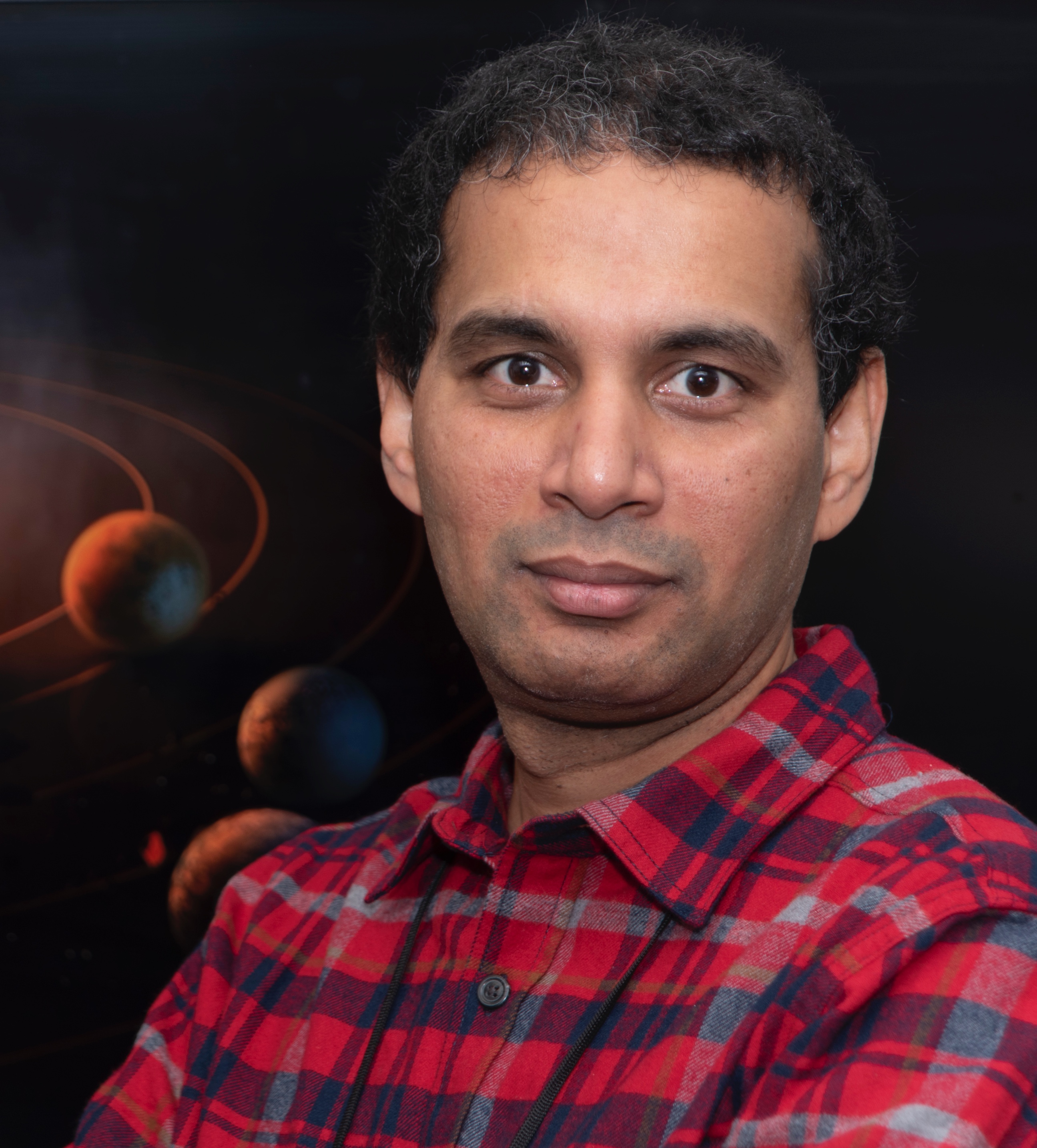
UAP research profile
Ravi Kumar Kopparapu
NASA Goddard planetary scientist and UAP sensor-data analyst
- TitleNASA Goddard planetary scientist and UAP sensor-data analyst
Overview
Ravi Kumar Kopparapu is a planetary scientist at NASA's Goddard Space Flight Center whose primary research concerns exoplanet habitability, atmospheric modelling, climate, biosignatures and technosignatures. He has worked at NASA Goddard since 2015 and received a NASA Exceptional Scientific Achievement Medal in 2020. [S1]
Kopparapu’s research base is NASA’s Goddard Space Flight Center in Greenbelt, Maryland. His planetary-science work there concerns atmospheric modelling and the interpretation of possible signs of life or technology. Those measurement problems provide relevant background for his later analysis of airborne UAP imagery. (NASA Goddard: Kopparapu biography.)
His UAP-specific public record is recent. In July 2026, Avi Loeb confirmed that Kopparapu and astrobiologist Jacob Haqq Misra had been added to the UAP Science Advisory Council. [S2]
In August, Kopparapu and Haqq Misra published a systematic preprint analysing 112 airborne UAP sensor videos released through the U.S. government's PURSUE initiative. Their principal conclusion was that the videos lack the complete range, platform-motion and sensor-geometry information needed to derive true object velocities. [S3]
Kopparapu's significance to UAP research lies less in a long history of UFO commentary than in applying mainstream planetary-science and measurement discipline to a contemporary government dataset. The institutional distinction matters: Kopparapu is a NASA scientist, but his participation in UAPSAC and the PURSUE paper should not automatically be described as an official NASA institutional position unless NASA itself states that it is.
NASA scientific career
NASA's Sciences and Exploration Directorate identifies Kopparapu as a planetary scientist in the Planetary Environments Laboratory at Goddard Space Flight Center. He earned a PhD in physics from Louisiana State University in 2006 and later held postdoctoral and research positions at Penn State before joining NASA Goddard. [S1]
His research focuses on the conditions that allow terrestrial planets to maintain liquid water, the modelling of planetary atmospheres and the characterisation of super-Earth and mini-Neptune atmospheres. He has also worked on technosignatures: remotely detectable indicators of technological activity on another world. [S1][S4] NASA publications have cited his work on exoplanet habitable zones, climate models and searches for atmospheric indicators of biology or technology. [S4][S5][S6] This is relevant to UAP research because Kopparapu's normal scientific work is based on inference from incomplete remote observations.
Astronomers cannot visit most exoplanets. They must derive physical properties from light, spectra, orbital geometry and models while testing whether alternative explanations can produce the same signal. UAP sensor analysis presents a related problem: what physical quantities can legitimately be recovered from limited remote observations?
Habitable-zone research
Kopparapu is well known for work refining the boundaries of circumstellar habitable zones. These models attempt to determine where liquid surface water could persist under different stellar and planetary conditions. NASA has used his research in public discussions of exoplanet habitability and the interpretation of Kepler discoveries. [S5][S6]
The relevance to UAP is indirect but important. A model is only useful if its inputs and assumptions are explicit. Scientific conclusions are not derived from the visual impression that a planet "looks habitable"; they come from measurable quantities such as stellar flux, atmospheric composition and climate behaviour. Kopparapu's PURSUE analysis applies the same principle to apparently fast-moving aerial objects: without the measurements needed to map angular motion into physical motion, the image cannot support a strong velocity claim.
Technosignatures
Kopparapu's NASA biography explicitly identifies technosignatures as a research interest. He has co-authored work considering whether atmospheric pollutants such as nitrogen dioxide could, under some circumstances, serve as remotely detectable indicators of technological activity on an exoplanet. [S1][S7] NASA has also featured him in public discussions about the scientific search for extraterrestrial life and technology. [S4] This background is especially relevant to UAP discourse because "technology" is a testable scientific category when appropriate evidence exists.
A credible technosignature requires evidence difficult to produce through natural processes and a framework for evaluating false positives. An unidentified object in a military video is therefore not automatically a technosignature. The physical evidence must positively discriminate technology, and if a non-human source is proposed, it must distinguish that from human technology and natural phenomena.
Joining the UAP Science Advisory Council
The initial UAPSAC roster announced in June 2026 did not publicly include Kopparapu. On 11 July, The Harvard Crimson reported that Avi Loeb had confirmed two additional astrobiology researchers—Jacob Haqq Misra and Ravi Kopparapu—had joined the council. [S2] The additions broadened the group's expertise in planetary atmospheres, habitability and the search for extraterrestrial life. Membership itself should not be treated as a finding about UAP.
The council is an advisory structure whose public scientific credibility depends on the quality of the data it receives and the transparency of its analytical outputs. UAPRAD's own governance review therefore correctly treats access, reproducibility and open methods as continuing tests of the council's value. [S8]
NASA affiliation and institutional attribution
Kopparapu's NASA affiliation creates a specific editorial risk. A scientist employed by NASA can conduct research, publish papers or participate in professional activities that do not necessarily represent an official agency conclusion. The public NASA biography reviewed for this profile establishes his employment and conventional research programme. [S1] The UAPSAC membership is established through public council reporting, not through a NASA announcement identified here.
Kopparapu's NASA Goddard affiliation identifies his professional position. His individual scientific work does not, by itself, establish NASA's institutional participation in UAPSAC or endorsement of the conclusions discussed here.
PURSUE and the 112-video corpus
By August 2026, the PURSUE release system had placed 112 airborne sensor videos into the public record. Many clips show small targets moving through infrared or electro-optical imagery. To a viewer, some appear to cross the image quickly. Kopparapu and Haqq Misra examined whether this apparent angular movement could be converted into true physical velocity. [S3]
The answer depended not on how dramatic the video looked, but on geometry. This shift from visual impression to measurable parameters is the central scientific contribution of their analysis.
Four quantities required for velocity recovery
The paper identifies four key quantities needed to infer physical velocity:
1. range from sensor to target; 2. observing aircraft velocity; 3. aspect angle between target motion and observer; 4. camera field angle. [S3]
No PURSUE video in the analysed corpus provided the entire set. This does not mean the underlying military system never recorded those quantities. It means the public releases did not preserve enough of them for an independent analyst to reconstruct the motion completely. The scientific conclusion is therefore about the released evidence. It should not be generalised into a claim about what classified analysts may or may not know from fuller data.
PR113: range degeneracy
The PR113 clip is particularly instructive. Visible depression-angle markings allowed the authors to reconstruct part of the camera field geometry. However, the target's range remained unknown. Without range, angular speed cannot uniquely specify linear speed.
The paper demonstrates that the same apparent image motion can be consistent with a small slow nearby target or a much larger fast distant target. [S3] This is an important corrective to public video analysis. A two-dimensional image does not encode depth automatically. Kopparapu's participation in this analysis is consistent with the broader logic of planetary remote sensing: different physical configurations can generate similar observables, and additional measurements are needed to break the degeneracy.
PR149: using a known-scale reference
PR149 provides a different example because a surface vessel appears in the image. The known or constrained size of that vessel provides a physical reference. Using this information, the authors derived an upper bound of roughly Mach 0.4 for the target's relative velocity under their analysis. [S3] The result does not necessarily identify the target. It shows that additional scale information can turn an otherwise ambiguous image into a more quantitative dataset.
For UAP research, this is an important methodological lesson: context is not ancillary metadata. It can determine whether extraordinary performance is actually supported.
Relationship to extraordinary claims
The PURSUE paper does not argue that the videos show extraterrestrial technology. It also does not dismiss every object as a bird, balloon or aircraft. The conclusion is narrower: the public videos, in their present form, generally cannot establish anomalous velocity. [S3] That restraint in interpreting the evidence is especially important given Kopparapu's technosignature background.
A researcher whose conventional work concerns extraterrestrial life could easily be portrayed in popular discussion as validating an alien interpretation. The paper does the opposite. It identifies missing data that prevent such an inference.
Publication status and peer review
As of 4 September 2026, the study is publicly available as an arXiv preprint. Haqq Misra's research bibliography lists a related journal manuscript as in review at the Journal of Aerospace Information Systems. [S9] The distinction matters. The preprint is a citable scientific work and its geometric reasoning can be independently inspected.
It has not yet completed the journal peer-review process. Its publication status and conclusions refer to the cited preprint version, which may change during review.
Contribution to UAPSAC methodology
Haqq Misra has stated that UAPSAC members provided recommendations for sensors that could generate better UAP data. [S10] Kopparapu's expertise makes him relevant to such work because planetary science routinely deals with instrumentation requirements, remote sensing and inverse problems. However, a complete public UAPSAC sensor protocol was not available in the sources reviewed here. The available record distinguishes:
- the publicly inspectable PURSUE paper;
- the reported existence of council sensor recommendations;
- any future field experiment, which must be assessed once its design is published.
Evidence analysis
Kopparapu's UAP record is strong in one important respect: it is tightly bounded. His conventional scientific career is well established. His council membership is recent. His main UAP scientific output asks a specific technical question and reaches a clearly limited conclusion.
This makes the profile less vulnerable to conflating biography with extraordinary claims. The most important limitation is that the PURSUE analysis concerns public releases rather than the full classified sensor record.
The paper demonstrates that public claims of extreme velocity are not warranted from the available clips alone. It cannot establish that fuller government data would necessarily be equally inconclusive.
Similarly, the paper does not identify the targets. It clarifies the limits of what can currently be determined from the evidence.
What is established
- Kopparapu is a NASA Goddard planetary scientist with a substantial research record in exoplanet habitability and atmospheric modelling. [S1]
- He received a NASA Exceptional Scientific Achievement Medal in 2020. [S1]
- His published interests include technosignatures and the remote detection of technological activity. [S1][S7]
- Avi Loeb confirmed his addition to UAPSAC in July 2026. [S2]
- He and Haqq Misra analysed 112 PURSUE airborne sensor videos. [S3]
- The paper found that no video contained the full parameter set needed to recover physical velocity. [S3]
- PR113 remains strongly range-degenerate; PR149 permits a more constrained upper-bound estimate because a scale reference is present. [S3]
- The study remains a preprint / journal submission in review as of the cutoff. [S9]
What is not established
- Kopparapu's UAPSAC participation is not, on the sources reviewed here, an official NASA institutional endorsement of the council.
- His expertise in technosignatures does not establish that UAP are extraterrestrial technology.
Overall assessment
Ravi Kopparapu is significant to this research because his UAP involvement brings an established remote-sensing and astrobiology scientist into direct contact with a public government UAP dataset. The most important result of that involvement is not evidence for extraterrestrial technology. It is a demonstration that many apparent performance claims cannot be recovered from imagery alone. This is scientifically valuable because UAP discourse often treats visual impression as physical measurement. Kopparapu and Haqq Misra show why that fails: angular motion, depth, platform motion and camera geometry are coupled.
His technosignature background adds an important conceptual discipline. The search for extraterrestrial technology is a legitimate scientific subject, but evidence of technology must be positively discriminating. Unidentified status is not enough.
Kopparapu's institutional affiliation and the ownership of his conclusions are distinct. He is a NASA scientist, but that does not automatically make his UAPSAC role or PURSUE paper a NASA position. At present, his strongest contribution is therefore methodological: defining what additional information must be available before a government UAP video can support quantitative claims about speed and performance.
Confidence by proposition
| Proposition | Confidence | Basis |
|---|---|---|
| Kopparapu is an established NASA Goddard planetary scientist | High | NASA biography |
| His mainstream work includes exoplanet habitability and technosignatures | High | NASA biography/publications |
| He is a UAPSAC member | High | Harvard Crimson / council reporting |
| He co-authored the systematic 112-video PURSUE analysis | High | Public preprint |
| The public videos establish anomalous velocities | Low | Paper finds required parameters missing |
| PR149 allows stronger kinematic constraints than most videos | High | Published analysis |
| Kopparapu's UAPSAC role represents an official NASA institutional conclusion | Low | No NASA institutional statement identified |
| His contribution improves methodological standards for UAP video interpretation | High | Direct focus of paper |
Sources
[S1] Primary institutional source — NASA Goddard Sciences and Exploration Directorate. Ravi Kumar Kopparapu biography. https://science.gsfc.nasa.gov/699/bio/ravikumar.kopparapu
[S2] Independent institutional reporting — The Harvard Crimson. "Inside Avi Loeb's New UAP Council, Built From His Harvard Orbit," 11 July 2026. https://www.thecrimson.com/article/2026/7/11/avi-loeb-uap-council/
[S3] Scientific preprint — Jacob Haqq-Misra and Ravi Kopparapu. "Limits on Kinematic Inference from the PURSUE Airborne Sensor Videos," arXiv:2608.12445v2, submitted 12 August 2026; revised 14 August 2026. https://arxiv.org/abs/2608.12445
[S4] Primary institutional science communication — NASA. "Gravity Assist: Do Other Planets Make Pollution? with Ravi Kopparapu," 8 April 2022. https://www.nasa.gov/podcasts/gravity-assist/gravity-assist-do-other-planets-make-pollution-with-ravi-kopparapu/
[S5] Primary institutional science communication — NASA. "About Half of Sun-Like Stars Could Host Rocky, Potentially Habitable Planets." https://science.nasa.gov/universe/exoplanets/about-half-of-sun-like-stars-could-host-rocky-potentially-habitable-planets/
[S6] Primary institutional science communication — NASA. "How Earth Climate Models Help Scientists Picture Life on Unimaginable Worlds." https://www.nasa.gov/centers-and-facilities/goddard/how-earth-climate-models-help-scientists-picture-life-on-unimaginable-worlds/
[S7] Peer-reviewed technosignature research listed by NASA biography — Kopparapu et al. "Nitrogen Dioxide Pollution as a Signature of Extraterrestrial Technology," The Astrophysical Journal 908(2), 164 (2021). NASA biography provides bibliographic record. https://science.gsfc.nasa.gov/699/bio/ravikumar.kopparapu
[S8] Internal cross-check — UAPRAD (not independent evidence). 2026 interagency governance and UAP Science Advisory Council. Related institutional analysis; not independent corroboration. https://uaprad.org/public-record
[S9] Primary research bibliography — Jacob Haqq Misra. Research page listing the related journal submission as in review. https://www.haqqmisra.net/research
[S10] Secondary scientific reporting with direct author comments — The Debrief. PURSUE analysis and council sensor-recommendation comments, 20 August 2026. https://thedebrief.org/scientists-just-analyzed-more-than-100-uap-videos-released-by-the-pentagons-pursue-program-this-is-what-they-learned/