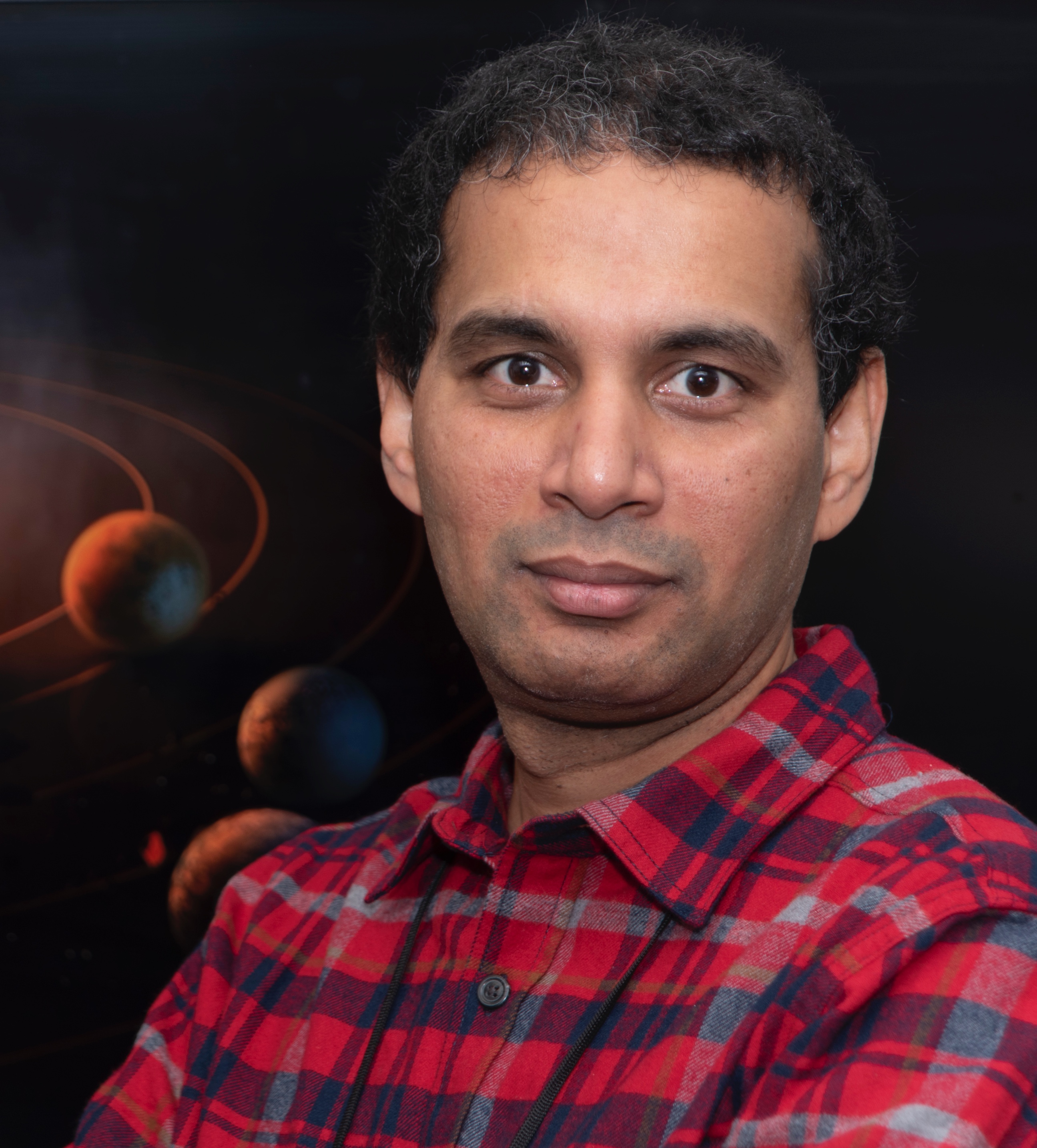
profil penelitian UAP
Ravi Kumar Kopparapu
Ilmuwan planet NASA Goddard dan coauthor analisis PURSUE
- JabatanIlmuwan planet NASA Goddard dan coauthor analisis PURSUE
Gambaran umum
Ravi Kumar Kopparapu adalah planetary scientist di NASA Goddard Space Flight Center. Riset utamanya meliputi exoplanet habitability, atmospheric modelling, climate, biosignatures, dan technosignatures. Ia bekerja di NASA Goddard sejak 2015 dan menerima NASA Exceptional Scientific Achievement Medal pada 2020. [S1]
Public record khusus UAP relatif baru.
Pada Juli 2026, Avi Loeb mengonfirmasi bahwa Kopparapu dan Jacob Haqq Misra telah bergabung dengan UAP Science Advisory Council. [S2]
Pada Agustus, mereka mempublikasikan preprint sistematis yang menganalisis 112 PURSUE airborne sensor videos. Kesimpulan utama: video publik tidak menyimpan complete range, platform-motion, dan sensor-geometry information yang diperlukan untuk mendapatkan true object velocities. [S3]
Arti pentingnya bagi UAPRAD bukan longstanding UFO commentary, tetapi penerapan mainstream planetary-science measurement/remote-sensing discipline pada contemporary government dataset.
Critical distinction: Kopparapu adalah NASA scientist, tetapi UAPSAC participation/PURSUE paper bukan otomatis official NASA institutional position.
Karier ilmiah NASA
NASA mengidentifikasi Kopparapu sebagai planetary scientist di Planetary Environments Laboratory, Goddard. Ia meraih PhD physics dari Louisiana State University pada 2006, kemudian bekerja di Penn State sebelum bergabung NASA Goddard. [S1]
Risetnya mencakup conditions untuk liquid water pada terrestrial planets, atmospheric modelling, dan super-Earth/mini-Neptune atmospheres.
Ia juga bekerja pada technosignatures: remotely detectable indicators of technological activity di dunia lain. [S1][S4]
NASA menampilkan karya habitable-zone, climate-model, dan atmospheric biology/technology indicators miliknya. [S4][S5][S6]
Ini relevan ke UAP karena mainstream science-nya sudah bergantung pada inference dari incomplete remote observations dan testing alternative models.
Habitable zones dan model discipline
Kopparapu dikenal karena memperbaiki circumstellar habitable-zone boundaries. [S5][S6]
Lesson untuk UAP: model hanya berguna bila inputs/assumptions eksplisit.
Planet tidak dinilai habitable karena "looks habitable"; perlu measurable quantities.
PURSUE menerapkan prinsip yang sama: tanpa measurements yang memetakan angular motion ke physical motion, imagery tidak mendukung strong velocity claim.
Technosignatures
NASA biography mencantumkan technosignatures sebagai research interest.
Kopparapu coauthor research tentang atmospheric nitrogen dioxide pollution sebagai potential remotely detectable technological indicator. [S1][S7]
NASA juga menampilkannya dalam public discussions mengenai extraterrestrial life/technology search. [S4]
Credible technosignature memerlukan positive discriminating evidence dan false-positive analysis.
Unidentified object dalam military video bukan otomatis technosignature.
UAPSAC membership
Initial June 2026 roster tidak publicly list Kopparapu.
Pada 11 Juli The Harvard Crimson melaporkan Avi Loeb mengonfirmasi penambahannya bersama Haqq Misra. [S2]
Membership memperluas expertise, tetapi bukan evidential finding.
Scientific credibility council bergantung pada data quality, reproducibility, dan open methods. [S8]
NASA affiliation dan institutional attribution
NASA affiliation menciptakan editorial risk.
Scientist bekerja di NASA dapat melakukan professional research/activity yang bukan agency conclusion.
NASA biography menetapkan employment/mainstream programme. [S1]
UAPSAC membership di sini ditetapkan lewat council reporting, bukan NASA announcement.
UAPRAD harus menulis "NASA Goddard planetary scientist Ravi Kopparapu" dan tidak mengubah personal participation menjadi "NASA joined UAPSAC".
PURSUE dan 112 videos
Pada Agustus 2026, 112 airborne sensor videos tersedia publik.
Many clips menunjukkan small targets tampak bergerak cepat dalam IR/EO imagery.
Kopparapu/Haqq Misra menguji apakah apparent angular motion dapat dikonversi menjadi true physical velocity. [S3]
Jawaban tergantung geometry.
Empat quantities
Paper mengidentifikasi: 1. sensor-target range; 2. observing aircraft velocity; 3. aspect angle; 4. camera field angle. [S3]
Tidak ada video yang memiliki complete set.
Ini tidak berarti original military system tidak pernah record data tersebut.
Ini hanya berarti public releases tidak mempertahankan cukup information untuk independent full reconstruction.
PR113: range degeneracy
PR113 mempertahankan depression-angle markings untuk partial camera geometry.
Target range masih unknown.
Tanpa range, angular speed tidak uniquely menentukan linear speed.
Same apparent motion dapat sesuai dengan small slow nearby target atau much larger fast distant target. [S3]
Ini classic inverse problem.
PR149: scale reference
PR149 mencakup surface vessel dengan approximate known size.
Reference ini memberi stronger geometric constraints.
Authors derive upper bound sekitar Mach 0.4 untuk relative velocity. [S3]
Tidak necessarily identify target; menunjukkan nilai contextual scale.
Hubungan dengan extraordinary claims
PURSUE paper tidak argue extraterrestrial technology.
Juga tidak identify setiap target sebagai bird/balloon/aircraft.
Kesimpulan narrower: public clips generally cannot establish anomalous velocity. [S3]
Dengan technosignature background, restraint ini penting: paper tidak validate alien interpretation, tetapi identify missing data yang menghalangi inference tersebut.
Publication status
Per 4 September 2026, study adalah arXiv preprint.
Haqq Misra bibliography mencantumkan related journal manuscript "in review" di Journal of Aerospace Information Systems. [S9]
Preprint citable, geometry reasoning inspectable, tetapi journal peer review belum selesai.
Final version perlu update.
UAPSAC methodology
Haqq Misra mengatakan UAPSAC members telah memberi sensor recommendations untuk better UAP data. [S10]
Kopparapu relevant karena remote sensing/inverse-problem expertise.
Namun complete public UAPSAC sensor protocol belum tersedia.
Harus dibedakan public PURSUE paper, reported recommendations, dan future experiments.
Analisis bukti
Kopparapu UAP record kuat karena tightly bounded.
Scientific career established.
Council membership recent.
Main output specific technical question dan limited conclusion.
Main limitation: PURSUE menganalisis public releases, bukan full classified sensor record.
Paper menunjukkan extreme velocity claims tidak warranted oleh clips alone; tidak membuktikan fuller government data sama inconclusive.
Yang telah ditetapkan
- Kopparapu established NASA Goddard planetary scientist. [S1]
- Menerima NASA Exceptional Scientific Achievement Medal 2020. [S1]
- Research interests termasuk technosignatures. [S1][S7]
- UAPSAC addition dikonfirmasi Juli 2026. [S2]
- Coauthor 112-video PURSUE analysis. [S3]
- No video memiliki full parameter set untuk physical velocity recovery. [S3]
- PR113 range-degenerate; PR149 memberi stronger scale constraint. [S3]
- Study masih preprint / journal submission in review. [S9]
Yang belum ditetapkan
- UAPSAC participation bukan official NASA endorsement berdasarkan sources reviewed.
- Technosignature expertise tidak establish UAP sebagai ET technology.
Penilaian keseluruhan
Ravi Kopparapu adalah strong addition karena established remote-sensing/astrobiology scientist berinteraksi langsung dengan public government UAP dataset.
Result terpenting bukan ET evidence.
Ia menunjukkan apparent performance claims sering tidak dapat recovered dari imagery alone.
Angular motion, depth, platform motion, camera geometry saling coupled.
Technosignature background menambahkan hypothesis discipline: extraterrestrial technology legitimate science question, tetapi "unidentified" tidak cukup.
Profile juga harus mencontohkan careful institutional attribution: NASA scientist ≠ NASA position.
Tingkat keyakinan per proposisi
| Proposisi | Keyakinan | Dasar |
|---|---|---|
| Kopparapu established NASA Goddard planetary scientist | Tinggi | NASA biography |
| Mainstream work mencakup habitability/technosignatures | Tinggi | NASA |
| UAPSAC member | Tinggi | Harvard Crimson/reporting |
| Coauthor 112-video PURSUE analysis | Tinggi | Public preprint |
| Public videos establish anomalous velocities | Rendah | Missing parameters |
| PR149 memberi stronger constraints | Tinggi | Paper |
| UAPSAC role represents official NASA conclusion | Rendah | No NASA statement |
| Contribution improves UAP-video methodology | Tinggi | Direct focus |
Sumber
[S1] NASA Goddard — Ravi Kumar Kopparapu. https://science.gsfc.nasa.gov/699/bio/ravikumar.kopparapu [S2] The Harvard Crimson. https://www.thecrimson.com/article/2026/7/11/avi-loeb-uap-council/ [S3] Haqq-Misra & Kopparapu — arXiv:2608.12445v2. https://arxiv.org/abs/2608.12445 [S4] NASA — Gravity Assist. https://www.nasa.gov/podcasts/gravity-assist/gravity-assist-do-other-planets-make-pollution-with-ravi-kopparapu/ [S5] NASA — Habitable planets. https://science.nasa.gov/universe/exoplanets/about-half-of-sun-like-stars-could-host-rocky-potentially-habitable-planets/ [S6] NASA — Climate models. https://www.nasa.gov/centers-and-facilities/goddard/how-earth-climate-models-help-scientists-picture-life-on-unimaginable-worlds/ [S7] NASA biography / NO2 technosignature bibliography. https://science.gsfc.nasa.gov/699/bio/ravikumar.kopparapu [S8] UAPRAD internal. https://uaprad.org/public-record [S9] Jacob Haqq Misra — Research. https://www.haqqmisra.net/research [S10] The Debrief. https://thedebrief.org/scientists-just-analyzed-more-than-100-uap-videos-released-by-the-pentagons-pursue-program-this-is-what-they-learned/