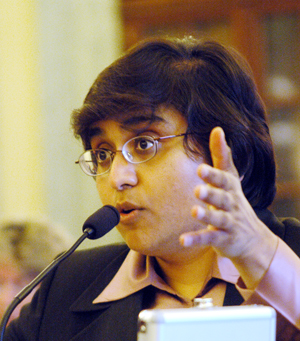
Jwilson377 · CC BY-SA 3.0 · Displayed with a circular CSS crop
UAP research profile
Anita Goel
Physicist-physician, nanobiophysics researcher and UAPSAC member
- TitlePhysicist-physician, nanobiophysics researcher and UAPSAC member
Overview
Anita Goel is a physicist, physician and biotechnology entrepreneur whose scientific work sits at the intersection of physics, nanotechnology, molecular biology and medical diagnostics. She holds a PhD in physics from Harvard University, an MD from the Harvard-MIT Division of Health Sciences and Technology and an undergraduate physics degree from Stanford University. She founded Nanobiosym and leads research and commercial programmes in nanobiophysics and portable molecular diagnostics. [S1][S2][S3]
Nanobiosym publishes its office in Cambridge, Massachusetts. Goel’s research career also connects Harvard, MIT and Stanford through her training in medicine and physics. These institutional associations place her UAP contribution within a background of physical measurement and diagnostic technology. (Nanobiosym: team and public office.)
Goel is a recent addition to the UAP Science Advisory Council (UAPSAC). Her public UAP-specific record is considerably newer and thinner than that of council members such as Kevin Knuth, Matthew Szydagis or Carol Cleland. By August 2026, she was publicly participating as a council member with Avi Loeb, Garry Nolan and Peter Skafish in a Sol Forum discussion about government data, prospective field research, sensors and the scientific requirements for determining the nature of UAP. [S4]
Goel is relevant to UAP research because she has an extensive scientific and technological career and now has an active, documented role in a significant 2026 UAP advisory structure. However, as of 4 September 2026, this review did not identify a peer-reviewed UAP-specific scientific paper authored by Goel. Her present importance is therefore prospective and methodological rather than the result of an established UAP discovery.
Scientific education and training
Goel's academic profile records a BS in physics with honours and distinction from Stanford University, MA and PhD degrees in physics from Harvard University and an MD from the Harvard-MIT Division of Health Sciences and Technology. [S1] The combination is unusual. Her research career was built around applying physical-science concepts at molecular and biological scales. Her own Harvard-hosted profile describes interests in molecular nanomachines, energy transduction, information processing in living systems, quantum mechanics, biosensors and nanoscale diagnostics. [S1]
This background is relevant to UAP primarily in two possible areas:
- multimodal sensing and instrumentation;
- evaluation of biological or material claims if appropriately controlled samples ever become available. It does not make her an aerospace dynamicist or UAP historian.
Nanobiosym
Goel founded Nanobiosym as a research and technology organisation operating at the intersection of physics, nanotechnology and biomedicine. [S1][S2] The organisation describes work on:
- rapid pathogen detection;
- biosensors;
- nanoscale diagnostic systems;
- molecular machines;
- information processing;
- energy harvesting. Its best-known applied platform is Gene-RADAR, a portable diagnostic system designed to detect genetic signatures. [S2][S3] XPRIZE records Goel as a winner of the Nokia Sensing XCHALLENGE for Gene-RADAR-related technology. [S3]
These achievements are relevant to her UAP role because they show experience converting abstract physical and biological measurement problems into sensor systems. The relevance is to measurement methods. A medical diagnostic platform cannot be repurposed conceptually into evidence that UAP are biological or non-human.
National Academies and advisory experience
Goel has also participated in scientific and technology advisory contexts outside her own company. The National Academies lists her as a participant in its Triennial Review of the National Nanotechnology Initiative and records her broader nanobiophysics and innovation background. [S5] Her Harvard profile lists roles and fellowships involving physics, technology and multidisciplinary scientific institutions. [S1][S6] This background helps explain why she might be useful to a multidisciplinary advisory council.
UAPSAC's challenge is not merely to interpret one sensor. It must consider what measurements would be required across different physical domains and how to design new data collection. Goel's strongest current fit is therefore systems thinking across physics, biology and sensing.
Joining UAPSAC
Goel was not prominent in the earliest June 2026 public roster. By August, the Sol Foundation was publicly featuring Goel as a council member in an extended discussion with Loeb, Nolan and Skafish. [S4] This chronology should remain explicit. Her council membership is current, but recent. The available chronology does not establish her participation from the council's formation.
Sol Forum discussion
The August 2026 Sol Forum is the most substantial public source for Goel's UAP role to date. [S4] The participants discussed:
- the data the council is requesting from government;
- the limitations of existing historical material;
- prospective field research;
- possible sensor deployment;
- what kinds of evidence would allow stronger scientific conclusions. Secondary summaries of the discussion record Goel emphasising the need for multimodal data with better spatial and temporal resolution and treating reports or testimony primarily as ways to guide questions and sensor placement rather than as substitutes for measurement. [S7]
This is methodologically significant. A UAP event recorded in multiple independent modalities is far more informative than one ambiguous image. For example, simultaneous optical, infrared, radar and environmental data can constrain different hypotheses.
Multimodal sensing
"Multimodal" can become a vague buzzword unless specified. The scientifically useful principle is independent measurement of different physical properties. Potential modalities include:
- visible imaging;
- infrared spectrum or temperature proxy;
- radar range and velocity;
- radio-frequency emission;
- acoustic/infrasonic signature;
- magnetic or electric-field measurements;
- environmental conditions. Agreement across independent sensors can reduce the probability that an event is an artefact of one instrument.
Disagreement can be equally informative. An optical target with no radar return may constrain size, material, range or sensor sensitivity. Goel's existing biosensor and molecular-diagnostics background makes the logic of orthogonal measurement familiar.
Prospective field experiment
UAPRAD's existing 2026 governance deep dive records that, by late August, Loeb described discussions with the government about a future field experiment involving scientific instrumentation. Goel participated in the public discussion of this proposed work. [S4][S8]
As of the review cutoff, however, no complete public protocol had been identified. Important details still absent included:
- location;
- deployment date;
- exact sensor package;
- target-selection rule;
- preregistration;
- data-release policy;
- external replication plan. The field experiment is therefore an important future development, not an accomplished scientific result. Goel's eventual contribution should be assessed when the experimental design becomes public.
Biology, materials and extraordinary claims
Some modern UAP allegations involve recovered materials or "biologics." Goel's combined physics, medical and nanotechnology background could make her technically relevant if authenticated samples were ever provided to a controlled scientific process. But an essential distinction remains. Expertise in molecular biology or nanobiophysics is not evidence that such samples exist.
No public source reviewed for this profile demonstrates that Goel has personally analysed a verified anomalous UAP material or biological specimen. Hypothetical future samples cannot substantiate a present research result. The correct current statement is that her expertise could be relevant to such analysis if a valid chain-of-custody sample became available.
Physics of life and consciousness
Goel's own research profile includes broad foundational interests in the physics of life, information and consciousness. [S1] These topics can overlap rhetorically with speculative UAP discussion. They should not be merged without evidence. Her work on quantum mechanics, molecular machines or consciousness does not imply a connection between UAP and consciousness.
If future UAP research makes such a claim, it should be supported independently. This is especially important because interdisciplinary language can create a false sense of explanatory unity between unrelated research areas.
Evidence analysis
Goel's scientific career is strong and independently documentable. Her UAP-specific contribution is currently much less mature. The strongest public evidence establishes:
- current council membership;
- participation in a substantive UAPSAC/Sol discussion;
- interest in multimodal sensing and prospective field collection. It does not yet establish:
- a peer-reviewed UAP paper;
- a completed UAP experiment;
- analysis of authenticated anomalous material;
- a specific empirical UAP finding. The distinction between participation and demonstrated findings should remain clear.
What is established
- Goel has advanced training in physics and medicine from Stanford, Harvard and the Harvard-MIT HST programme. [S1][S3]
- She founded and leads Nanobiosym. [S1][S2]
- Her established work concerns nanobiophysics, molecular machines, diagnostics and biosensing. [S1][S2]
- She has received recognised innovation awards, including XPRIZE-related recognition for sensing technology. [S3]
- She has participated in National Academies scientific/technology advisory activity. [S5]
- She became a UAPSAC member in 2026 and was publicly participating in council work by August. [S4]
- She participated publicly in council discussion about multimodal data and prospective field sensing. [S4][S7]
- As of the review date, her public UAP record is much newer than her conventional scientific record.
What is not established
- Goel's scientific credentials do not establish any extraordinary UAP claim.
- No peer-reviewed UAP-specific paper authored by Goel was identified in this review.
Overall assessment
Anita Goel brings established scientific expertise to an emerging UAP research role. Her conventional scientific record is substantial. She brings an unusual combination of physics, medicine, molecular biology, nanotechnology and sensor development into a council whose next major challenge appears to be designing better prospective data collection. That makes her potentially valuable.
It does not yet establish a substantial body of UAP findings. The strongest part of her current contribution is methodological: the need to collect multiple independent measurements of the same event rather than repeatedly infer physical properties from isolated imagery. Her participation in discussions of a future field experiment suggests that this expertise may become operationally relevant. Her biotechnology achievements and foundational physics interests do not, by themselves, establish UAP findings.
Her established career explains why she was recruited. Her future UAP scientific output will determine how important the appointment ultimately becomes. A published experimental protocol or a specific analysis involving Goel would provide a firmer basis for evaluating that contribution.
Confidence by proposition
| Proposition | Confidence | Basis |
|---|---|---|
| Goel has a substantial physics/medicine/nanotechnology career | High | Harvard, XPRIZE, Nanobiosym and National Academies records |
| She has recognised experience in sensing/diagnostic technology | High | Gene-RADAR/XPRIZE record |
| She is a current UAPSAC member | High | Loeb/Sol public record |
| She has publicly participated in discussion of UAP field sensors | High | Sol Forum record |
| She has published a peer-reviewed UAP-specific scientific paper | Low | None identified as of cutoff |
| She has analysed authenticated anomalous UAP materials | Low | No public evidence identified |
| Her expertise could be useful in multimodal or biological/material analysis | Moderate–High | Strong disciplinary fit, conditional on data availability |
| Her present UAP importance is prospective rather than based on a major empirical result | High | Current public record |
Sources
[S1] Primary academic profile — Harvard-hosted Anita Goel profile. Education, research interests and scientific roles. https://sites.harvard.edu/goel/
[S2] Primary organisational source — Nanobiosym. Team and research mission. https://www.nanobiosym.com/our-team/ https://www.nanobiosym.com/mission/
[S3] Independent innovation profile — XPRIZE Foundation. Anita Goel. https://www.xprize.org/people/anita-goel
[S4] Primary organisational media — The Sol Foundation. Inside the UAP Science Advisory Council with Members Garry Nolan, Anita Goel, and chair Avi Loeb, 20 August 2026. Published through the Sol Forum. https://thesolfoundation.org/the-sol-forum/
[S5] Independent scientific-advisory source — National Academies. Triennial Review of the National Nanotechnology Initiative, participant profile for Anita Goel. https://www.nationalacademies.org/projects/DEPS-NMMB-14-01/event/8014
[S6] Primary academic profile — Anita Goel professorships/fellowships. https://sites.harvard.edu/goel/home/activities/professorships/
[S7] Secondary summary of the Sol Forum discussion. Useful for locating statements about multimodal data; replace with timestamped primary video citation during final edit. https://en.noticiasufologicas.com.br/radar/conselho-consultivo-cientifico-sobre-uaps-pediu-mais-de-50-itens-de-dados-ao-governo-dos-eua-diz-avi-loeb/
[S8] Internal cross-check — UAPRAD (not independent evidence). 2026 UAP Governance Board / Science Advisory Council, including the late-August proposed field experiment. Related institutional analysis; not independent corroboration. https://uaprad.org/public-record