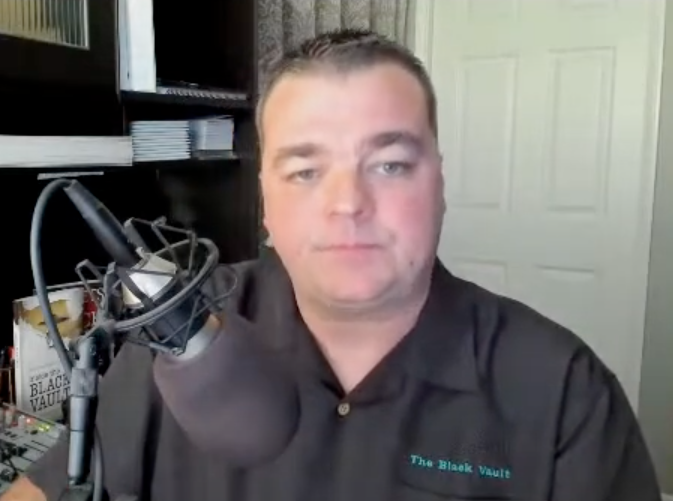
Max Moszkowicz · CC BY-SA 2.5 · Displayed with a circular CSS crop
UAP research profile
John Greenewald Jr.
FOIA researcher and founder of The Black Vault
- TitleFOIA researcher and founder of The Black Vault
Overview
John Greenewald Jr. is an American Freedom of Information Act (FOIA) researcher and founder of The Black Vault, a privately maintained online archive of declassified and publicly released government records. His significance to the modern UAP record lies primarily in documentary acquisition rather than in advancing a particular explanation for unidentified anomalous phenomena. Since beginning to file FOIA requests as a teenager in 1996, Greenewald has built an archive that, as of this review, reports more than 3.8 million pages of government material spanning intelligence, defence, aviation, historical events and UFO/UAP subjects. [S1]
The Black Vault publishes a correspondence address in Castaic, California. Its document collection draws on Freedom of Information Act requests to U.S. federal agencies, connecting Greenewald’s online archive with government records produced and released across the country. (The Black Vault: correspondence contact.)
Greenewald's principal contribution is making documents available for independent examination. Many public debates about UAP depend on claims about what a government agency said, knew, withheld, investigated or released. A successful FOIA request can replace second-hand description with an identifiable primary record. That does not make the contents of the record true by default. It establishes that the document exists, was held or processed by the relevant agency, and was released under a defined request and exemption framework.
This distinction is central to assessing Greenewald. His work is strongest as documentary infrastructure: obtaining records, preserving agency response letters, maintaining request histories and making material accessible for independent review. What each document establishes must still be assessed separately.
Origins of The Black Vault
The Black Vault states that Greenewald began filing FOIA requests in 1996, when he was 15 years old. The archive subsequently expanded beyond UFO records into a much broader collection covering the CIA, FBI, Department of Defense, intelligence agencies, nuclear policy, military operations and other government subjects. [S1]
The site currently describes itself as one of the largest privately maintained collections of declassified government documents and displays a live page count of 3,861,432 government-document pages at the time of this review. The archive contains millions of pages; any precise total describes its holdings at a particular date rather than a permanent quantity. [S1]
The archive's importance is not simply scale. Records are usually retained alongside identifying information such as the agency, request number, release date and response correspondence. This often allows a researcher to distinguish an original government PDF from later commentary about it.
FOIA as a research method
Greenewald's work is built around a process that has both substantial strengths and clear limitations. Under FOIA, the wording of a request helps determine the scope of an agency's search for responsive records. Department of Justice guidance explicitly notes that the request defines what the agency is being asked to locate, and that responsive records may then be withheld in whole or in part under statutory exemptions. [S2][S3]
This means a FOIA result should never be interpreted as a complete inventory of everything an agency knows about a subject. A response of "no responsive records" may mean that a particular search using a particular scope did not locate responsive material. A release may contain redactions. Records can also be withheld in full, referred to another agency, excluded under statutory provisions or remain outside the systems searched in response to that request. [S3]
Conversely, a released record is not automatically proof that every claim written inside it is accurate. Government files contain raw reports, correspondence, allegations, working notes, preliminary assessments and statements by outside parties. Documentary provenance answers the question "where did this record come from?" It does not necessarily answer "is every proposition in it true?" Greenewald's strongest contribution is therefore methodological: he makes the provenance and administrative history of a document easier to inspect.
UAP records and government correspondence
The Black Vault contains a substantial UFO/UAP document collection, including records from the CIA, DIA, FBI, Navy, Air Force, Office of the Secretary of Defense, FAA, National Reconnaissance Office and other agencies. [S1][S4] Several modern UAP requests illustrate why this work matters.
Navy video-release records
After the public circulation and later official acknowledgement of the FLIR1, GIMBAL and GOFAST videos, Greenewald filed FOIA requests seeking records concerning how the Navy and Department of Defense handled those videos and their public release. A Navy response to FOIA case DON-NAVY-2020-007231 records his request for communications, memoranda, reviews and other material associated with the decision to place the three UAP videos on the Naval Air Systems Command FOIA website. [S5] Separate releases obtained through The Black Vault contain internal communications involving Pentagon spokespersons and military officials discussing the videos, their terminology and media handling. [S6]
The importance of such records is not that they resolve what the objects in the videos were. Their value is administrative. They document how the Department discussed, reviewed and communicated about evidence that had become central to public UAP debate.
Nimitz and "range fouler" material
Greenewald also filed requests for Navy records relating to incidents involving the USS Theodore Roosevelt and other UAP reporting, including requests for reports, investigations and supporting material. Navy response correspondence establishes the scope of these requests and shows how much material was released or withheld. [S7]
These releases have helped researchers examine the language used in military reports, the distinction between public summaries and internal records, and the degree to which additional information remains classified or exempt. Again, a collection of reports is not a collection of confirmed extraordinary craft. It is a collection of government records about observations that entered official reporting systems.
UAPTF, intelligence agencies and interagency records
Following the 2021 ODNI Preliminary Assessment, Greenewald sought records from agencies identified as contributors to UAP Task Force activity. A 2024 National Reconnaissance Office response documents a request for communications between the NRO and UAPTF, including records that might show how the agency supplied input to the 2021 assessment. [S8]
The significance of this type of request is that it can reconstruct institutional process. Public reports commonly name contributing agencies but provide little detail on how information moved between them. FOIA can sometimes expose tasking, briefing, email and coordination records that allow later researchers to test the public narrative against contemporaneous administrative material.
The limitation is predictable: intelligence-community responses frequently invoke exemptions, security restrictions or redaction. The existence of a heavily redacted record shows that responsive material was identified, but the missing content cannot responsibly be filled with speculation.
AARO-era document work
Greenewald has continued filing requests concerning AARO, including its historical-report process, internal communications, contact with outside organisations and attempts to engage witnesses. In 2024, The Black Vault published documents showing AARO's attempts to contact David Grusch. The release included an internal memorandum summarising efforts by the office to arrange an interview. [S9]
This type of material is valuable because public disputes can otherwise depend on competing recollections. A contemporaneous memorandum does not automatically establish every participant's interpretation, but it creates a dated record of what the office documented internally.
Other requests have obtained communications concerning AARO's interactions with Enigma Labs, the rollout of the Historical Record Report and Pentagon communications about UAP messaging. [S10][S11] The site has also published cases in which requests yielded extensive redaction or apparent tension between a public government statement and a later FOIA response. Such material can identify questions for further investigation but should not automatically be characterised as proof of deception. FOIA searches and public-affairs statements are produced through different administrative processes, and inconsistencies require case-specific examination.
FAA and aviation records
Greenewald's requests have extended into civil aviation. A 2024 FAA response to a request for communications involving UAP-related keywords released 129 pages of records, while withholding portions under several FOIA exemptions. [S12]
This is particularly relevant because aviation reporting has historically been fragmented across military, FAA, NASA ASRS and private channels. FOIA records can document how civil aviation officials communicate about UAP even when no single public-facing programme explains the full institutional process.
The release demonstrates the existence of responsive FAA communications. It does not demonstrate the physical nature of the incidents discussed inside them.
The archive as a research tool
The Black Vault's value is greatest when users treat it as a source library rather than as a conclusion engine. A well-preserved government response can help answer:
- whether an agency held responsive records;
- when a request was filed and completed;
- what search terms or subjects were requested;
- which exemptions were invoked;
- whether records were released, redacted or withheld;
- what language government personnel used contemporaneously;
- whether later public claims are consistent with earlier internal documents.
This can materially improve UAP research. It moves debate away from statements such as "the Pentagon said" toward identifiable documents with dates and administrative provenance.
It can also reveal limitations in the available documentation. A heavily redacted release may demonstrate that a topic generated internal communication while still leaving the substantive issue unresolved.
Editorial and analytical approach
Greenewald frequently provides his own interpretation of released material through articles, podcasts and commentary. These should be separated from the underlying documents. The evidential hierarchy is:
1. the original agency document or response letter; 2. the administrative context of the FOIA request; 3. Greenewald's summary of what the release contains; 4. any broader inference about what the documents imply.
Where The Black Vault hosts the only readily accessible copy of an agency release, the document itself can still be treated as a primary-source reproduction if its identifying features and request history are intact. The hosting website and the evidential status of the document are separate questions.
This distinction is especially important when commentary uses language such as "reveals", "contradiction", "secrecy" or "cover-up". Those interpretations may be reasonable in a specific case, but their strength depends on whether they follow from the documentary facts.
Limitations of FOIA-based research
FOIA is one of the most powerful public tools for reconstructing U.S. government activity, but it cannot provide total visibility.
First, FOIA applies to records, not to undocumented knowledge. If an event generated no retrievable record within the searched systems, the process cannot produce one.
Second, national-security, privacy, law-enforcement, deliberative and other exemptions can remove critical context. [S3] Third, search scope matters. A narrowly framed request may miss material that would respond to a differently worded request. Department of Justice guidance makes clear that the universe of records processed depends on what the requester asked the agency to find. [S2]
Fourth, an agency's failure to locate a record does not logically establish that the underlying event never occurred. It establishes a result within that FOIA process.
Finally, released records can themselves contain inaccurate statements. A raw intelligence report documenting an extraordinary claim is evidence that the claim was reported to the government, not necessarily evidence that the claim was verified.
These limitations do not reduce the importance of Greenewald's work. They define how it should be used.
Evidence analysis
Greenewald's contribution is unusually straightforward to verify. Many of his outputs are not claims about private access or unnamed sources; they are government response letters and released records carrying identifiable agency markings and request numbers. This gives his documentary work a high level of provenance.
The principal analytical risk arises after the document is obtained. A record can be authentic while the event described within it remains uncertain. A redaction can be genuine while its hidden content remains unknowable. A delayed FOIA response can demonstrate administrative delay without explaining the cause. A difference between two government statements may indicate an inconsistency worth investigating without proving intentional deception.
Greenewald is therefore most important as a generator and curator of primary-source material. The strongest use of The Black Vault is to cite the document, examine the request history and then conduct independent analysis.
What is established
- Greenewald began filing FOIA requests in 1996 and created The Black Vault as a public government-document archive. [S1]
- The Black Vault currently holds millions of pages of government records across many subject areas. [S1]
- The archive includes substantial UFO/UAP material from U.S. defence, intelligence and aviation agencies. [S1][S4]
- Numerous government response letters identify Greenewald as the requester in UAP-related FOIA cases. [S5][S7][S8][S12]
- His requests have produced records concerning the Navy UAP videos, UAPTF-related communications, FAA records and AARO activity. [S5][S8][S9][S12]
- FOIA results are shaped by request scope, agency searches and statutory exemptions. [S2][S3]
What is not established
- A document's release under FOIA does not establish that every factual assertion inside it is correct.
- A "no records" response does not necessarily establish that the underlying event or subject never existed.
Overall assessment
John Greenewald Jr.'s principal contribution is the acquisition and preservation of records that other researchers can inspect.
That makes his work particularly valuable in a field where claims frequently outrun documentary provenance. The Black Vault can convert a circulating quotation into a full response letter, a claimed government position into an identifiable memorandum, or a general assertion of secrecy into a specific record showing what was actually withheld.
The method has clear limits. FOIA is a search-and-disclosure mechanism operating within legal exemptions, not an omniscient audit of government knowledge. Released documents can be incomplete, redacted, misleading or factually wrong. A requester can reveal a record without resolving the event described inside it.
Greenewald's historical importance therefore lies in strengthening the documentary basis of UAP research. His archive does not answer what UAP are. It improves the ability to test what government agencies have recorded, released, withheld and said about them. That is a substantial contribution because transparent source provenance is a prerequisite for a better assessment of the evidence.
Confidence by proposition
| Proposition | Confidence | Basis |
|---|---|---|
| Greenewald founded and operates The Black Vault | High | Archive's own history plus agency response records |
| The archive contains millions of government-document pages | High at dated snapshot | Live archive count |
| He has obtained significant modern UAP records through FOIA | High | Agency response letters and releases |
| A Black Vault-hosted government PDF can remain a primary source | High when provenance is verified | Identifiable agency documents/request numbers |
| FOIA can reveal the complete government record on UAP | Low | Exemptions, search scope and inaccessible records |
| A released UAP report verifies the physical interpretation in that report | Low | Release establishes documentary provenance, not necessarily factual accuracy |
| Greenewald's own commentary should be treated as primary evidence | Low | Commentary is secondary to the documents obtained |
Sources
[S1] Primary organisational source — The Black Vault. Document Archive, archive history and current government-document page count. https://www.theblackvault.com/documentarchive/
[S2] Primary legal/process guidance — U.S. Department of Justice, Office of Information Policy. "Defining a Record Under the FOIA." https://www.justice.gov/oip/oip-guidance/defining_a_record_under_the_foia
[S3] Primary legal/process guidance — U.S. Department of Justice, Office of Information Policy. FOIA request and response guidance, including exemptions and fully withheld records. https://www.justice.gov/oip/make-foia-request-doj
[S4] Documentary archive — The Black Vault. "All UFO Documents From..." agency document collections. https://www.theblackvault.com/documentarchive/all-ufo-documents-from/
[S5] Primary government response — Department of the Navy. FOIA case DON-NAVY-2020-007231, records concerning FLIR1, GIMBAL and GOFAST release processing. Hosted document reproduction. https://documents2.theblackvault.com/documents/navy/2020-007231.pdf
[S6] Primary government records hosted by The Black Vault. Pentagon communications concerning GIMBAL, FLIR1 and GOFAST, released under FOIA. https://www.theblackvault.com/documentarchive/emails-from-pentagon-spokesperson-uncovered-on-gimbal-flir1-and-gofast-ufo-videos/
[S7] Primary government response — Department of the Navy. FOIA response concerning reports associated with Roosevelt-era UAP incidents. https://documents2.theblackvault.com/documents/navy/RFReportsNavyRedacted%28202306%29.pdf
[S8] Primary government response — National Reconnaissance Office. FOIA case F-2021-00152 concerning NRO communications with UAPTF. https://documents2.theblackvault.com/documents/nro/F-2021-00152.pdf
[S9] Primary records / documentary release — AARO-related correspondence obtained under FOIA. The Black Vault summary and linked release concerning attempts to interview David Grusch. https://www.theblackvault.com/documentarchive/foia-documents-reveal-aaros-authorized-and-repeated-attempts-to-engage-with-david-grusch/
[S10] Documentary release — The Black Vault. AARO / Enigma Labs communications obtained under FOIA. https://www.theblackvault.com/documentarchive/foia-response-reveals-contact-between-aaro-and-enigma-labs-details-remain-largely-redacted/
[S11] Documentary release — The Black Vault. Pentagon communications concerning rollout of AARO Historical Record Report obtained under FOIA. https://www.theblackvault.com/documentarchive/foia-emails-reveal-pentagons-tight-control-over-aaro-historical-record-report-rollout-and-messaging/
[S12] Primary government response — Federal Aviation Administration. FOIA case 2024-04951, UAP/UFO keyword communications. https://documents2.theblackvault.com/documents/faa/2024-04951.pdf