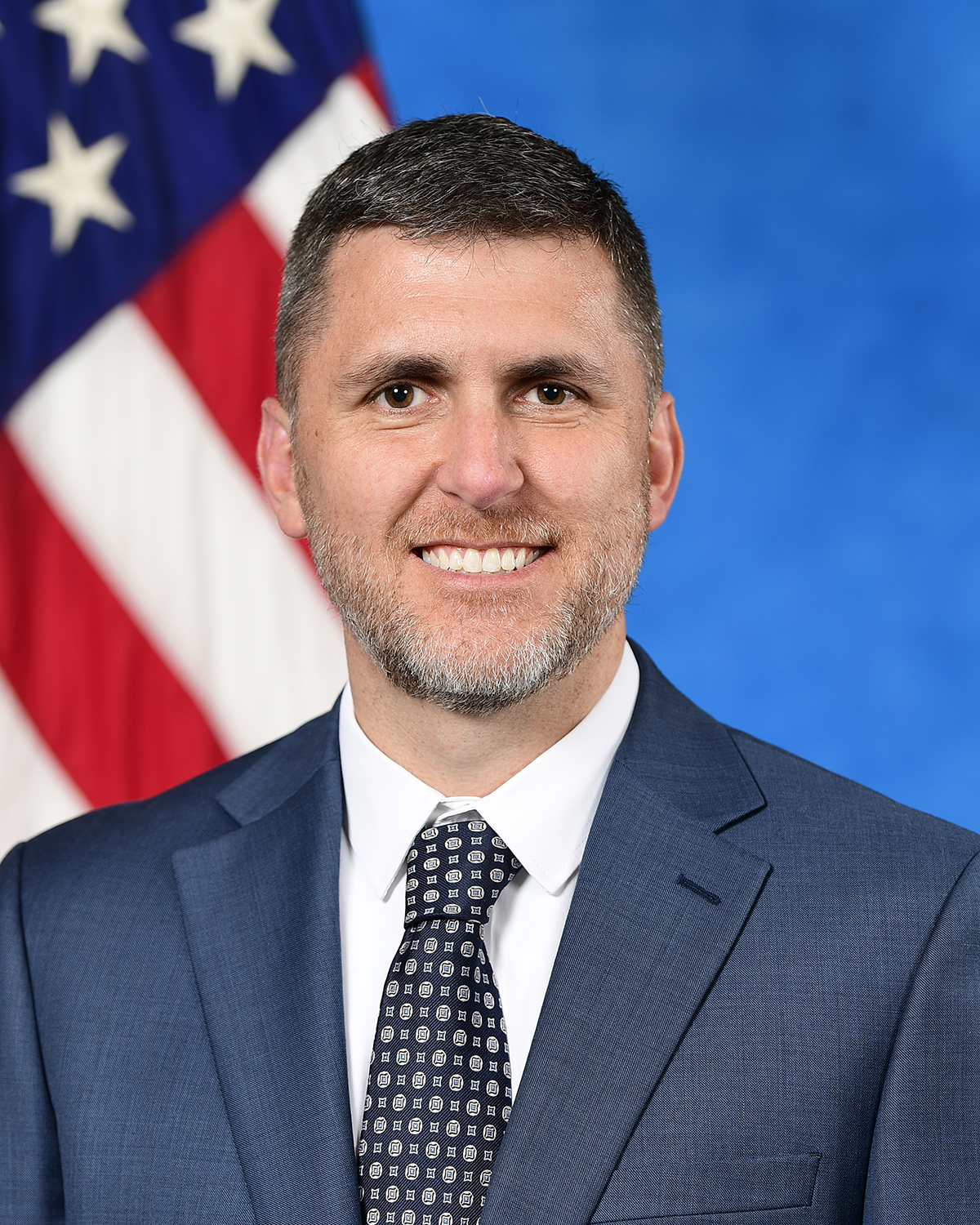
UAP research profile
Jon T. Kosloski
Director of the All-domain Anomaly Resolution Office
- TitleDirector of the All-domain Anomaly Resolution Office
Overview
Jon T. Kosloski is the Director of the U.S. Department of Defense's All-domain Anomaly Resolution Office (AARO), the organisation assigned to receive, analyse and resolve reports of unidentified anomalous phenomena across U.S. national-security domains. He assumed the role in August 2024 after a career centred on technical research and intelligence work at the National Security Agency (NSA). His importance to the UAP record therefore derives primarily from institutional responsibility: during his tenure, AARO has continued to build a central reporting archive, develop analytical tools, publish case resolutions and provide Congress with consolidated assessments of UAP reporting. [S1][S2]
Kosloski presented AARO’s work at the Dirksen Senate Office Building in Washington, D.C., on 19 November 2024. The hearing connected the office’s case analysis with Senate Armed Services oversight and provided a public account of its investigative activity during his directorship. (Senate Armed Services hearing, November 2024.)
Kosloski is not principally significant as a witness or claimant. The relevant record is the work of the office he directs, the methodological standards he has publicly described, and the limits that remain on what AARO can establish from the data available to it.
Professional background
AARO's official biography records that Kosloski previously held technical and leadership positions in the NSA Research Directorate. His work included networking and computing, free-space optics, optics research, crypto-mathematics and specialised communications. He holds bachelor's degrees in mathematics and physics from California State University, San Bernardino, and a PhD in electrical engineering from Johns Hopkins University. His doctoral research concerned optical receivers designed to detect very weak phase-encoded signals, followed by experimental work with scientists at the National Institute of Standards and Technology. He is also a graduate of the NSA Cryptanalysis Development Program. [S1]
This background is directly relevant to AARO's remit. Much of contemporary UAP analysis concerns the interpretation of sensor data, signal quality, imaging artefacts, geometry, platform characteristics and the distinction between genuinely unusual observations and ordinary objects recorded under difficult conditions. Kosloski's technical credentials do not by themselves validate any particular AARO conclusion, but they establish that his appointment was grounded in fields relevant to measurement and intelligence analysis rather than public advocacy concerning UAP.
Appointment to AARO
The Department of Defense announced Kosloski as AARO Director on 26 August 2024. AARO's public products subsequently identified his November 2024 appearance before the Senate Armed Services Committee's Subcommittee on Emerging Threats and Capabilities as his first major open congressional presentation in the role. [S2][S3]
In his written statement, Kosloski described AARO as approaching reports near national-security sites seriously and with scientific rigour. He said that when he arrived in August 2024 the office had received more than 1,600 UAP reports. He emphasised three immediate priorities: strengthening partnerships, increasing transparency and scaling the office's ability to process the volume and diversity of incoming material. [S3]
He also described a broad network of intended partners, including the military services, intelligence agencies, national laboratories, the FBI, Department of Homeland Security, NASA, academia and the scientific community. This is significant because AARO's statutory problem is not simply to catalogue reports. It must obtain enough contextual and sensor information to test competing explanations, often across data held by different organisations.
What AARO says the evidence shows under Kosloski
AARO's public position under Kosloski has remained that most resolved cases are attributable to ordinary objects or effects and that a substantial fraction of unresolved cases remain unresolved because the available data are insufficient. Kosloski told the Senate in November 2024 that many reports resolve to birds, balloons and unmanned systems, while other cases cannot be resolved because the necessary data are absent. He also stated that a small percentage of cases merited further investigation because they appeared potentially anomalous. In the same testimony, he said AARO had found no verifiable evidence of extraterrestrial beings, activity or technology in the material it had analysed. [S3]
That statement requires careful scope. It is an institutional finding about AARO's holdings, access and analysis; it is not a logical claim that every UAP report has been explained or that no unknown phenomenon could exist. Kosloski himself said AARO would not prematurely foreclose possible explanations. The distinction between "unresolved" and "evidence of an extraordinary origin" is central to interpreting AARO's work.
FY2025 reporting and analytical progress
AARO's Fiscal Year 2025 Consolidated Annual Report, released publicly in July 2026, provides the clearest quantitative view of the office's work during Kosloski's tenure. The report states that AARO received 319 UAP reports within the reporting period. It resolved 114 of those reports and, using new analytical capability, also resolved 256 reports from earlier reporting periods, for 370 resolutions completed during the period. The resolved cases were attributed to prosaic causes, including ordinary airborne objects; the report additionally identified a commercial rocket and a manned jet pack among resolved observations. [S4]
A particularly important development was AARO's modelling of satellite flaring. The office reported that this capability allowed it to resolve 238 previously reported UAP as reflections associated with satellites. This illustrates an important feature of UAP analysis: a phenomenon can appear unusual to an observer or sensor and still become identifiable when geometry, timing and external datasets are brought together. [S4]
The same report also records the limitations. As of 30 May 2025, AARO's holdings contained 1,870 reports. Of the 319 reports received during the reporting period, 191 were transferred to an active archive because there was insufficient data for further analysis. Nine reports merited further analysis with intelligence-community or science-and-technology partners. AARO explicitly stated that transfer to the active archive does not mean that a case exhibited anomalous performance; it means the available information was insufficient to determine what occurred. [S4]
This is one of the most important safeguards against overstating AARO statistics. A count of unresolved or archived reports cannot be treated as a count of technologically anomalous objects.
Transparency and classification
Kosloski has publicly acknowledged that AARO's ability to explain cases in public is constrained by classification. He told the Senate that classification commonly protects sensor characteristics, collection locations, sources and methods rather than the mere fact that an object was observed. He also noted that AARO cannot unilaterally declassify information owned by another part of government and must work with the originating authority. [S3]
This creates an unavoidable difference in access to the evidence. AARO can state that it has examined classified information, but external researchers cannot independently audit all of that material. Conversely, the existence of classified supporting data does not establish that the underlying phenomenon is extraordinary. The appropriate conclusion is narrower: portions of AARO's analytical basis cannot be reproduced publicly, and confidence in those conclusions therefore depends partly on institutional process rather than open replication. AARO has nevertheless expanded its public case-document and reporting pages, and its public products page now includes annual reports, hearing material and individual case records. [S2][S5]
Evidence analysis
Kosloski's tenure is best assessed at three levels. First, the documented institutional facts are strong. His appointment, technical background, congressional testimony and AARO's published reporting are official records.
Second, there is evidence of increased analytical capacity. Satellite-flare modelling produced a large set of specific resolutions, and AARO continues to publish individual case analyses. These are measurable outputs rather than statements of intent alone. However, because much of the underlying sensor data is not public, not every resolution can be independently reproduced by outside researchers.
Third, the principal unresolved problem remains data quality. AARO repeatedly states that many reports cannot be resolved because timely, sufficiently detailed sensor and contextual data are missing. This limitation constrains both conventional and extraordinary interpretations. Poor data can prevent identification of an ordinary object just as readily as it can obscure genuinely unusual behaviour.
What is established
- Kosloski is the current Director of AARO. [S1]
- He has an established technical and intelligence-research background in mathematics, physics, electrical engineering, optics, computing and cryptanalysis. [S1]
- He assumed the AARO directorship in August 2024. [S2]
- AARO has continued to expand its UAP reporting, case-resolution and public-document functions during his tenure. [S2][S4][S5]
- The FY2025 report records 370 resolutions completed during its reporting period, including 238 cases resolved through satellite-flare analysis. [S4]
- A large number of reports remain analytically incomplete because the available data are insufficient. [S4]
- Kosloski has stated publicly that AARO has found no verifiable evidence of extraterrestrial beings, activity or technology in the material it has analysed. [S3]
What is not established
- The number of unresolved or archived AARO reports does not establish an equivalent number of genuinely anomalous craft or technologies.
- AARO's public reporting does not provide enough underlying data for independent reproduction of every classified or sensor-dependent resolution.
Overall assessment
Kosloski matters to the UAP record because he directs the principal U.S. government office charged with resolving contemporary UAP reports. His significance is institutional and methodological rather than testimonial. The strongest evidence associated with his tenure concerns the creation and application of analytical processes: report aggregation, partnerships, satellite-flare modelling, case resolution and the attempt to distinguish genuinely unresolved observations from identifiable objects or sensor effects.
The public record also shows the limits of that programme. AARO continues to receive more reports than can be fully analysed, and a large subset lack the data needed for a defensible identification. The existence of these cases should neither be converted into evidence of extraordinary technology nor dismissed as proof that nothing unusual occurred. In many instances, the available evidence is simply insufficient.
Kosloski's most consequential contribution may ultimately be whether AARO can move UAP investigation away from retrospective narratives and towards better characterised sensor observations. The FY2025 report offers evidence of progress in analytical tooling, particularly satellite-flare identification, but it also demonstrates that collection quality remains the central bottleneck. Assessment of his tenure should therefore rest on transparent methodology, case-level evidence and measurable improvements in data quality rather than on the unresolved-case count alone.
Confidence by proposition
| Proposition | Confidence | Basis |
|---|---|---|
| Kosloski is the current Director of AARO | High | Official AARO biography |
| His professional background is strongly relevant to sensor and intelligence analysis | High | Official education and NSA career record |
| AARO materially expanded specific analytical capability under his tenure | Moderate–High | FY2025 report, including satellite-flare modelling |
| AARO's FY2025 unresolved/archived cases demonstrate anomalous technology | Low | AARO explicitly states many are archived for insufficient data |
| AARO has publicly reported no verifiable extraterrestrial evidence in its analysed holdings | High | Kosloski's congressional statement |
| The public can independently audit all of AARO's conclusions | Low | Classification and unavailable raw sensor data limit replication |
Sources
[S1] Primary — AARO. "Dr. Jon T. Kosloski — Director." Official biography. https://www.aaro.mil/About/Leaders/
[S2] Primary — AARO. "Congressional/Press Products." Includes the 26 August 2024 appointment announcement and later congressional products. https://www.aaro.mil/Congressional-Press-Products/
[S3] Primary — AARO / U.S. Senate hearing record. Jon T. Kosloski, Statement for the Record, Senate Armed Services Committee, Subcommittee on Emerging Threats and Capabilities, 19 November 2024. https://www.aaro.mil/Portals/136/PDFs/Dr_Jon_Kosloski_Statement_for_the_Record_SASC_Open_Hearing_Nov2024.pdf
[S4] Primary — AARO. Fiscal Year 2025 Consolidated Annual Report on Unidentified Anomalous Phenomena, publicly released July 2026. https://www.aaro.mil/Congressional-Press-Products/
[S5] Primary — AARO. UAP Report Documents / case-document repository. https://www.aaro.mil/Next-AARO-Home-redesign/Next-Parent/Next-UAP-Report-Documents/