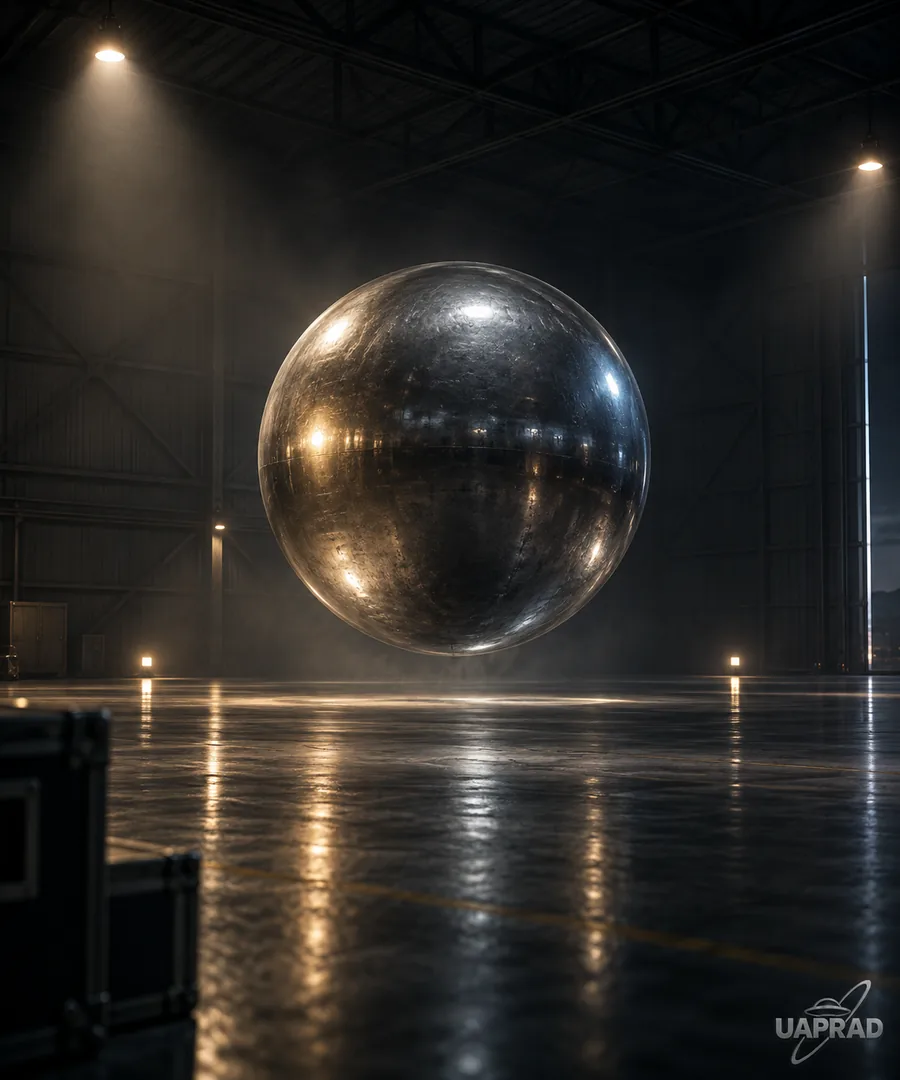
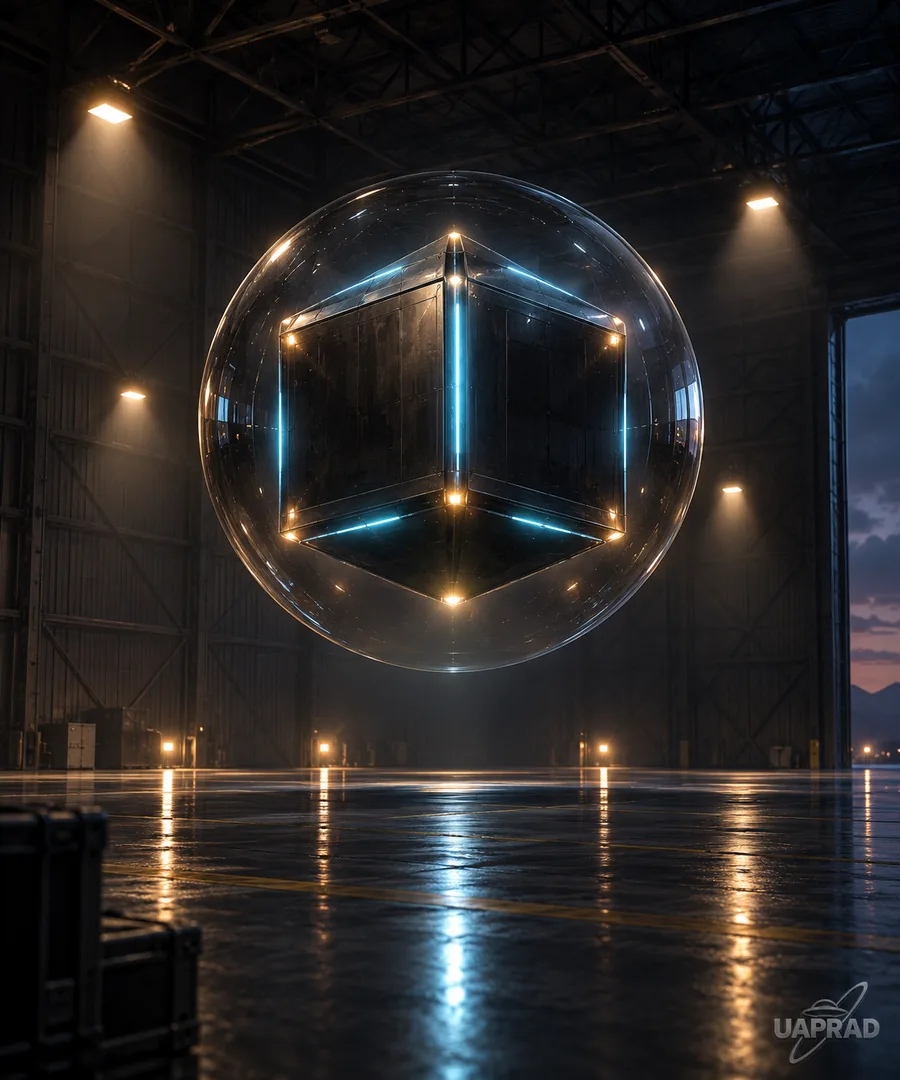
Spherical objects and unresolved lights whose apparent boundary is circular.
sphereorbglobeball of light
ChatGPT-generated UAPRAD original.
Overview
Sphere and orb reports include daylight descriptions of apparently bounded objects, luminous observations and round targets in electro-optical or infrared imagery. The same appearance can also be produced by balloons, astronomical sources, meteors, focus error or sensor bloom. The category records reported form; it does not establish a single object class.
Classification
A resolved morphology requires a stable bounded form. An apparent morphology records a reasonable visual impression without secure three-dimensional geometry; a sensor-image morphology records how a target appears in pixels or contrast. Physical-form confidence is assessed separately so that a round image is not treated automatically as a spherical body.
Reported descriptions
Reported forms range from opaque or metallic-looking daylight spheres to white, orange or red luminous balls. Some accounts describe a smooth boundary and no visible appendages; others establish only a bright point, a circular image or an area of contrast.
Slow drift, steady translation and apparent hovering occur frequently, but these behaviours are also characteristic of balloons and distant sources with low angular motion. Reports of rapid or erratic movement require platform motion, stabilisation, tracking and range data before physical speed can be inferred.
Historical development
Round and ball-shaped descriptions predate the modern use of ‘orb’. Project Twinkle attempted instrumented observation of recurrent luminous phenomena in New Mexico, while Project Blue Book files applied similar shape language to cases later classified as balloons, astronomical effects, meteors and unidentified reports.
The historical record therefore contains continuity of vocabulary rather than evidence of one continuous phenomenon. Continental Divide combined visual and radar reporting; Warren changed from a ball-like appearance to an elongated profile as the viewing aspect changed; other files show how a bright point near the horizon could acquire an apparently large spherical form.
Contemporary reporting
AARO’s current reporting table lists 229 reports as ‘Orb/Round/Sphere’, or 38.6 per cent of reports with morphology data in the displayed period. This is the largest published bin. The table does not disclose the underlying cases or distinguish a resolved sphere from an unresolved light or sensor image, so it measures reporting prevalence rather than a verified physical class.
Report catalogue
Retained records are classified by the evidence that supports the reported form. Alternate assignments identify genuine overlap; resolved outlines, apparent shapes and sensor-image morphology remain distinct.
5 or 15 August 1950 · Great Falls, Montana, United States
Great Falls film
Unresolved
Nick Mariana and his secretary reported two bright objects, and Mariana recorded about 16 seconds of 16 mm film. His early description called them disc-shaped lights, but the surviving film mainly resolves bright sources. The Colorado study found aircraft difficult, though not impossible, to reconcile with the sequence and left the case unexplained.
Evidence
Sensor-image morphology
Morphology confidence
Moderate
Physical form
Indeterminate
Witnesses
Two civilian witnesses
Evidence profile
F
Early report of two disc-shaped lights; film does not securely resolve structure
Daylight observation near an air base; event date is disputed
V
Two witnesses and 16 mm film
R
Substantial formal analysis, with disputed date and missing alleged opening frames
P
At least about 50 seconds visually; 16 seconds on surviving film
X
Two sources maintaining relative position
26 January 1953 · Continental Divide, New Mexico, United States
Continental Divide radar-visual report
Unresolved
Air Force personnel reported a ball-shaped source with intermingled white, red and green light while an air-control and warning radar recorded an unidentified return. The Project Blue Book file links the visual and radar observations but also records possible weather effects and a radiosonde release. Its unidentified evaluation preserves an incomplete investigation, not confirmation of a spherical vehicle.
Evidence
Apparent morphology
Morphology confidence
Moderate
Physical form
Unresolved luminous target
Witnesses
Military visual observers and radar operators
Evidence profile
F
Ball-shaped source; no resolved surface or structural detail
E
Intermingled white, red and green appearance
K
Slow movement and periods of apparent hovering reported
I
None reported
C
Night observation from a military radar site
V
Visual testimony and an air-control radar report
R
Contemporary official file with possible visual-radar correlation; weather and radiosonde uncertainties remain
P
Extended observation reported
X
One reported source
17 August 1958 · Warren, Michigan, United States
Warren daylight report
Unresolved
A civilian observer using field glasses described a bright circular grey-white form with concentric detail. As it rotated and departed, he reported an elongated, centrally raised profile. Project Blue Book left the case unidentified. The changing appearance makes it useful for studying viewing aspect and cross-category assignment, but the single account supplies no measured range or image.
Evidence
Apparent morphology
Morphology confidence
Moderate
Physical form
Probable bounded object
Witnesses
Single civilian witness
Evidence profile
F
Circular or ball-like form changing to an elongated rimmed profile as its aspect changed
E
Bright centre and grey-white outer form; no exhaust reported
K
Initial apparent stationarity followed by rotation, arcing movement and departure
I
None reported
C
Daylight observation with aircraft reportedly passing in the foreground
V
Single witness account using field glasses and an official case file
R
Contemporary file preserves detailed testimony; no photograph, range measurement or second witness
P
Approximately ten minutes reported
X
One reported object
1 November 2002 · Cazères-sur-l’Adour, Landes, France
Cazères-sur-l’Adour luminous-ball report
Unresolved
A witness reported a fire-coloured ball accompanied by several flashing lights and brief changes of direction. GEIPAN classifies the case D, but the published record does not resolve a physical surface, range or three-dimensional form. It is retained as an unresolved luminous-orb report rather than evidence of a bounded sphere.
Evidence
Apparent morphology
Morphology confidence
Moderate
Physical form
Unresolved luminous orb
Witnesses
Civilian witness report
Evidence profile
F
Fire-coloured ball with several accompanying flashing lights reported
E
Luminous presentation
K
Several back-and-forth movements reported
I
None established
C
Night-time ground observation
V
Witness account and GEIPAN case record
R
Officially investigated but without measurements sufficient to resolve physical form
P
Approximately 30 seconds reported
X
One principal luminous ball with several lights reported
2022 · Middle East
AARO Middle East orb
Unresolved
An MQ-9 electro-optical sensor recorded a round target that AARO describes as a spherical object. AARO retains the case in its Active Archive because poor data prevent conclusive attribution and states that the target did not appear to exhibit anomalous performance. The public material supports an official apparent-sphere classification more strongly than a resolved three-dimensional form.
Evidence
Sensor-image morphology
Morphology confidence
Moderate
Physical form
Round target; three-dimensional form unresolved
Witnesses
Military sensor observation
Evidence profile
F
Round sensor target officially described as spherical
E
Bright or reflective appearance in electro-optical imagery
K
No anomalous performance established by AARO
I
None reported
C
Military MQ-9 observation in the Middle East
V
Electro-optical video and official mission briefing
R
Official provenance; AARO states that poor data prevent attribution
P
Brief recorded episode
X
One target
15 October 2022 · CENTCOM area
PURSUE PR053 infrared recording
Unresolved
The uploader-defined title describes the target as ‘cigar shaped or fast spherical’. AARO identifies the source as likely military infrared imagery and states that the media was digitally altered before upload; the released file also contains slowed replays. The record preserves genuine morphology ambiguity and cannot distinguish physical outline from motion, optics and processing.
Evidence
Sensor-image morphology
Morphology confidence
Low
Physical form
Unresolved sensor target
Witnesses
Military sensor record
Evidence profile
F
Ambiguous elongated or round image; morphology comes from the uploader title
E
Infrared contrast
K
Brief rapid transit with slower replays
I
None reported
C
Likely U.S. military platform in the CENTCOM area
V
Digitally altered derivative infrared video
R
Officially released; native imagery, range and full telemetry are not public
P
Twenty-one-second released file containing a brief transit and replays
X
One target
October 2023 · Western United States
Western United States ‘mother orb’ reports
Partially explained
Six federal agents in three teams reported orange luminous objects that they called ‘mother orbs’, with smaller red lights appearing nearby. AARO correlated about 60 per cent of the reported activity with military infrared-countermeasure flares and retained a residual for further investigation. The residual hypothesis rests on testimony and exclusion, without event imagery or technical measurements.
Evidence
Apparent morphology
Morphology confidence
Moderate
Physical form
Unresolved luminous sources
Witnesses
Six federal law-enforcement agents in three teams
Evidence profile
F
Orange and red luminous orbs described by witnesses; no resolved surface
E
Orange principal lights and smaller red lights
K
Brief appearances, apparent production of smaller lights and one prolonged stationary light reported
I
No physical interaction established
C
Night observations near a sensitive national-security site
V
Multiple narrative accounts and AARO deconfliction; no event imagery or technical data
R
Credible professional witnesses from several positions; estimates remain unmeasured and may not be fully independent
P
Reports across two days
X
Multiple reported luminous sources
1 July 2025 · Northeastern United States
Northeastern United States red-sphere report
Unresolved
Two witnesses reported brilliant red spheres with bright white centres moving silently near a tree line and apparently merging as they departed. AARO’s released description records the FBI’s favourable credibility assessment and provides government-hosted video. These points strengthen provenance but do not establish range, physical surface or the witnesses’ interpretation of merging.
Evidence
Apparent morphology
Morphology confidence
Moderate
Physical form
Unresolved luminous orbs
Witnesses
Two civilian witnesses
Evidence profile
F
Two round luminous sources with bright centres reported
E
Brilliant red appearance with white centres
K
Tandem silent movement and apparent merging during departure reported
I
None reported
C
Night observation near a tree line in the northeastern United States
V
Two witness accounts, smartphone video and government release
R
Named institutional provenance and favourable witness assessment; no independent range or surface resolution
P
Single recorded event
X
Two reported sources
Cases and witnesses
UAPRAD case pages reconstruct the incidents in full. Witness pages preserve the roles and testimony behind the morphology assignment.
The 2022 Middle East recording is the most prominent official example. AARO describes a spherical object recorded by an MQ-9 electro-optical sensor, but states that poor data prevent attribution and that the object did not appear to show anomalous performance. The released material does not provide the range and angular detail needed to establish secure three-dimensional form.
Recent PURSUE records demonstrate a different problem. PR053 carries an uploader-defined ‘cigar shaped or fast spherical’ title and contains altered, replayed infrared material; the Western United States event rests on testimony rather than event imagery; the 2025 northeastern sphere report includes witness testimony and government-hosted video without independent range. These records are useful when their different evidential roles remain visible.
Sensor evidence
A circular sensor image may represent a spherical object, an unresolved non-spherical target or the imaging system’s response to a point source. Defocus, diffraction, glare, saturation, motion blur, compression and infrared contrast can all alter apparent form. None of the retained unresolved sensor cases publicly combines native calibrated imagery, independent range, platform state data and a second viewing geometry sufficient to reconstruct a stable three-dimensional sphere.
Recurring characteristics
Roundness and a simple outline recur by definition. White, orange and red luminosity is common in night reports, while metallic, grey or dark descriptions appear more often in daylight. The difference may reflect viewing and sensor conditions as much as distinct source types.
Absence of visible wings, control surfaces or surface detail is frequent but weakly diagnostic at low angular resolution. Multiple lights or apparent orbs also require separate trajectory evidence before coordinated behaviour or a single larger structure can be inferred.
Identification and interpretation
Identification problems
Balloons can produce a bounded metallic or dark sphere, wind-consistent translation and apparent hovering. Astronomical sources, satellites and meteors can produce luminous orb impressions when distance cues are weak. Each hypothesis must be tested against the observation’s timing, angular path, duration and environmental conditions.
Optical and digital effects can explain apparent roundness without identifying the underlying source. A defocused aircraft light remains a physical aircraft; an infrared contrast area may correspond to a physical target whose outline the sensor does not resolve. ‘Artefact’ should therefore be applied to the image feature, not used automatically to deny a source object.
Resolved and explained controls
Controls show how similar appearances can arise without assuming that the same explanation applies to every record.
2 July 1952 · Near Tremonton, Utah, United States
Tremonton film
Plausibly explained
Delbert Newhouse filmed a group of bright sources moving in a clear sky. A later account described paired-saucer profiles, but the early record and film did not resolve metallic structure. The Colorado study found the film consistent with birds and treated the later disc description as less secure than the original account.
Evidence
Sensor-image morphology
Morphology confidence
Low
Physical form
Unresolved light or sensor signature
Witnesses
Family group led by an experienced naval photographer
Evidence profile
F
Bright near-point sources; later saucer description not present in the earliest account
E
Sunlit or self-luminous appearance unresolved
K
Group milling with one source separating
I
None reported
C
Clear daylight sky without range reference
V
Witness accounts and 16 mm film
R
Good camera provenance but weak physical-form resolution
P
Approximately 75 seconds of film
X
Rough group of ten or more sources
6 August 1952 · Tucson, Arizona, United States
Tucson / Davis–Monthan spherical-object report
Resolved
Military tower observers and a C-47 pilot reported a brilliant spherical object without visible projections or exhaust. The local Air Intelligence report assessed the source as a balloon. The case is a useful control because comparatively detailed military testimony supported spherical appearance without requiring an unconventional object.
Evidence
Resolved morphology
Morphology confidence
High
Physical form
Resolved conventional sphere-like source
Witnesses
Multiple military observers and pilot
Evidence profile
F
Brilliant spherical form without reported projections
E
Bright reflective appearance; no exhaust reported
K
Movement assessed as compatible with a balloon
I
None reported
C
Daylight military airfield observation involving tower and airborne witnesses
V
Multiple witness accounts and local Air Intelligence report
R
Strong contemporary documentation; official evaluation identified a balloon
P
Single observation
X
One source
20 July 1958 · Midwest City, Oklahoma, United States
Midwest City bright-ball report
Resolved
A military observer reported a very large bright white ball apparently hovering near the horizon and emitting heat-wave-like distortion. Project Blue Book evaluated the sighting as refraction associated with Jupiter. The file shows how an astronomical point source and atmospheric conditions can acquire apparent size, proximity and surface activity.
Evidence
Apparent morphology
Morphology confidence
Low
Physical form
Resolved astronomical lookalike
Witnesses
Single military observer
Evidence profile
F
Large round bright source inferred from a low-horizon point
E
Bright white appearance and apparent heat waves
K
Apparent hovering followed by disappearance near the horizon
I
None reported
C
Night observation with Jupiter setting in the reported direction
V
Witness account, astronomical context and official case file
R
Contemporary investigation identified a matching astronomical and refractive explanation
P
Brief observation
X
One apparent source
7 April 1980 · Saint-Usuge, Saône-et-Loire, France
Saint-Usuge luminous-ball report
Resolved
Two motorists reported a red-orange luminous ball whose apparent position changed during an extended night drive. GEIPAN ultimately attributed the observation to the Moon and the changing viewing geometry. The case is a control for apparent hovering or jumping when a distant astronomical source lacks stable distance cues.
Evidence
Apparent morphology
Morphology confidence
Low
Physical form
Resolved astronomical lookalike
Witnesses
Two civilian witnesses
Evidence profile
F
Red-orange luminous ball; no resolved surface
E
Steady luminous appearance
K
Apparent jumps and rise during observer movement
I
Strong emotional response; no physical effect
C
Night observation from a moving vehicle
V
Two-witness testimony and GEIPAN reconstruction
R
Official analysis matched the apparent behaviour to the Moon and changing geometry
P
Approximately ten minutes reported
X
One apparent source
17 July 2021 · La Seyne-sur-Mer, Var, France
La Seyne-sur-Mer bright-sphere report
Resolved
A witness described a smooth bright sphere, likened to a pétanque ball, descending on a straight path under clear conditions. GEIPAN classifies the case A and identifies a Mylar balloon. The report is a close descriptive analogue for metallic-orb claims and demonstrates that a convincing bounded appearance can have a conventional source.
Evidence
Resolved morphology
Morphology confidence
High
Physical form
Resolved conventional sphere-like source
Witnesses
Single civilian witness
Evidence profile
F
Smooth bright bounded sphere
E
Strong reflected light
K
Straight descending drift
I
None reported
C
Clear-sky daylight or early-evening garden observation
V
Witness account and GEIPAN comparative analysis
R
Official investigation identified a Mylar balloon
P
Approximately 15 seconds reported
X
One source
25 January 2025 · Artigues-près-Bordeaux, Gironde, France
Artigues-près-Bordeaux metallic-sphere report
Plausibly explained
Two witnesses reported a black metallic-looking sphere moving slowly and in a straight line during daylight. GEIPAN classifies the case B and assesses a Mylar balloon as probable. It provides a recent control closely matching the surface, form and motion often used to distinguish ‘metallic orbs’ from luminous points.
Evidence
Resolved morphology
Morphology confidence
High
Physical form
Probable conventional sphere-like source
Witnesses
Two civilian witnesses
Evidence profile
F
Black metallic-looking sphere
E
Reflective daylight appearance
K
Slow rectilinear movement
I
None reported
C
Daylight two-witness observation
V
Witness testimony and GEIPAN investigation
R
Official case record; Mylar balloon assessed as probable rather than certain
P
Single observation
X
One source
Research and analysis
NASA’s 2023 independent study identifies calibration, metadata and coordinated observations as prerequisites for reliable physical characterisation. The Galileo Project’s proposed multimodal observatories are relevant for the same reason: wide- and narrow-field imaging, radar-derived range, spectra and environmental measurements could separate a nearby bounded sphere from a distant point source. This instrumentation work is relevant to aerial morphology; research on recovered metallic spherules is not evidence for reported aerial orbs.
Balloons and lighter-than-air objects
Resolved cases show that reflective, smooth and apparently spherical targets can drift or hover conventionally. A balloon explanation still requires compatible wind, altitude and trajectory.
Astronomical, atmospheric and space sources
Planets, satellites and meteoric phenomena account for many luminous-ball presentations. They fit poorly where a nearby bounded surface or incompatible trajectory is established.
Unresolved physical targets
Some reports support the presence of a discrete target while leaving its identity and precise geometry open. Unresolved status does not establish anomalous performance or exotic origin.
A recurring engineered sphere
The repeated label permits this as a hypothesis, but the present corpus mixes resolved conventional sources, lights, altered imagery and heterogeneous testimony. No common material, calibrated signature or performance profile links them as one vehicle class.
Evidence assessment
Sphere / Orb is the largest morphology category in AARO’s current published reporting table, but prevalence of the label does not establish prevalence of spherical craft. The retained reports range from daylight descriptions and radar-visual material to unresolved lights and low-resolution sensor images. Resolved controls show that balloons, astronomical sources, meteors and optical effects can reproduce much of the same appearance. The evidence supports a major morphology of reporting and several unresolved individual cases; it does not establish common construction, behaviour or origin across the category.
Research gaps
Independent range through triangulation, radar, lidar or known geometry.
Resolved multi-angle imagery showing a stable three-dimensional boundary.
Native media, original metadata and documented chain of custody.
Platform state vectors, line-of-sight angles and timestamps sufficient to reconstruct kinematics.
Calibrated visible, infrared and spectral measurements rather than colour or brightness descriptions alone.
Wind, weather, astronomical, air-traffic, satellite and balloon-launch data for the time and location.
Repeated observations from fixed calibrated stations with cross-sensor corroboration.
Source library
Sources are grouped by evidential role. A tier records provenance and directness; it does not determine whether a reported interpretation is correct.
Tier 2 Official and institutional records
AARO UAP Reporting Trends — AARO lists Orb/Round/Sphere as its largest published morphology bin; the aggregate does not establish the physical form or identity of the underlying reports.
AARO Mission Brief 2025 — The briefing describes the Middle East orb as unresolved because of poor data and states that it did not appear to exhibit anomalous performance.
Project Twinkle final report and correspondence — The file documents an instrumented investigation of reported green fireballs and shows the difficulty of deriving structure from luminous observations.
NASA UAP Independent Study Team final report — NASA explains why calibrated sensors, metadata and coordinated measurements are required before apparent morphology can support physical characterisation.
Edward J. Ruppelt: Project Twinkle account — Ruppelt’s account provides institutional context for Project Twinkle and should be read alongside the surviving official file.