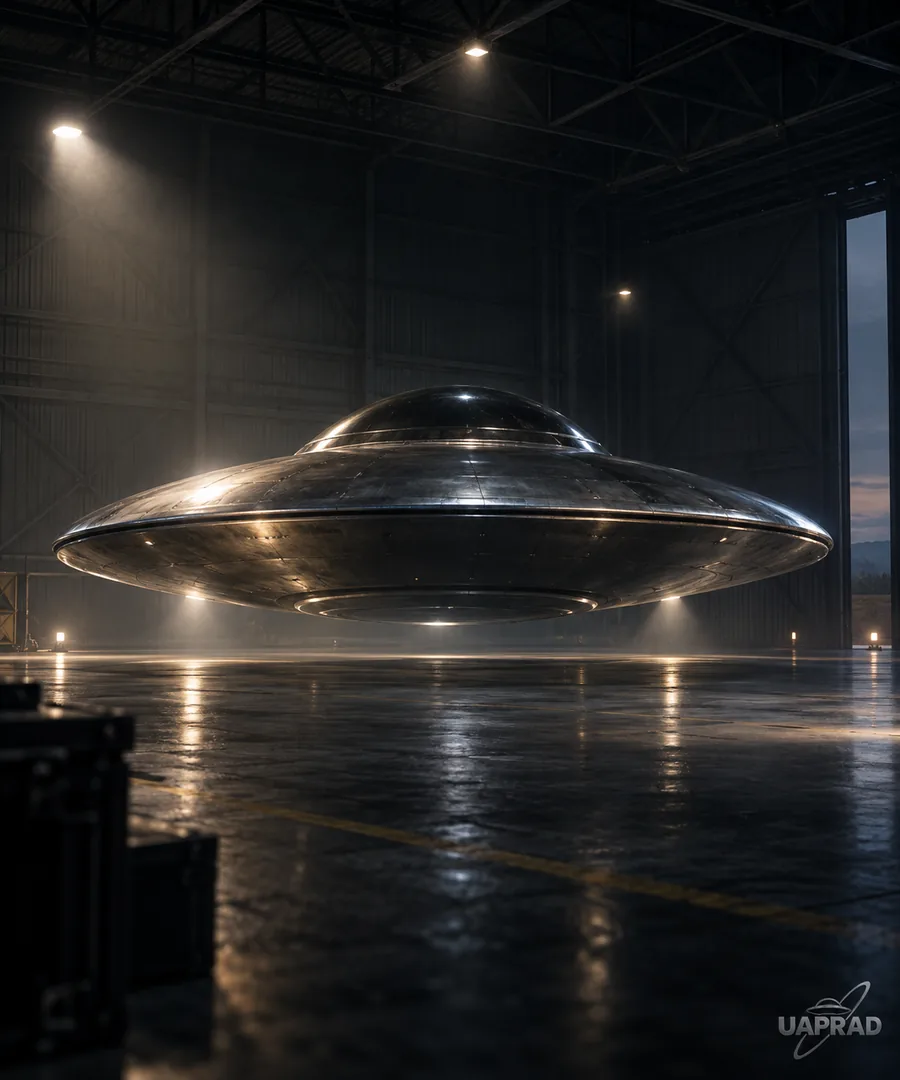
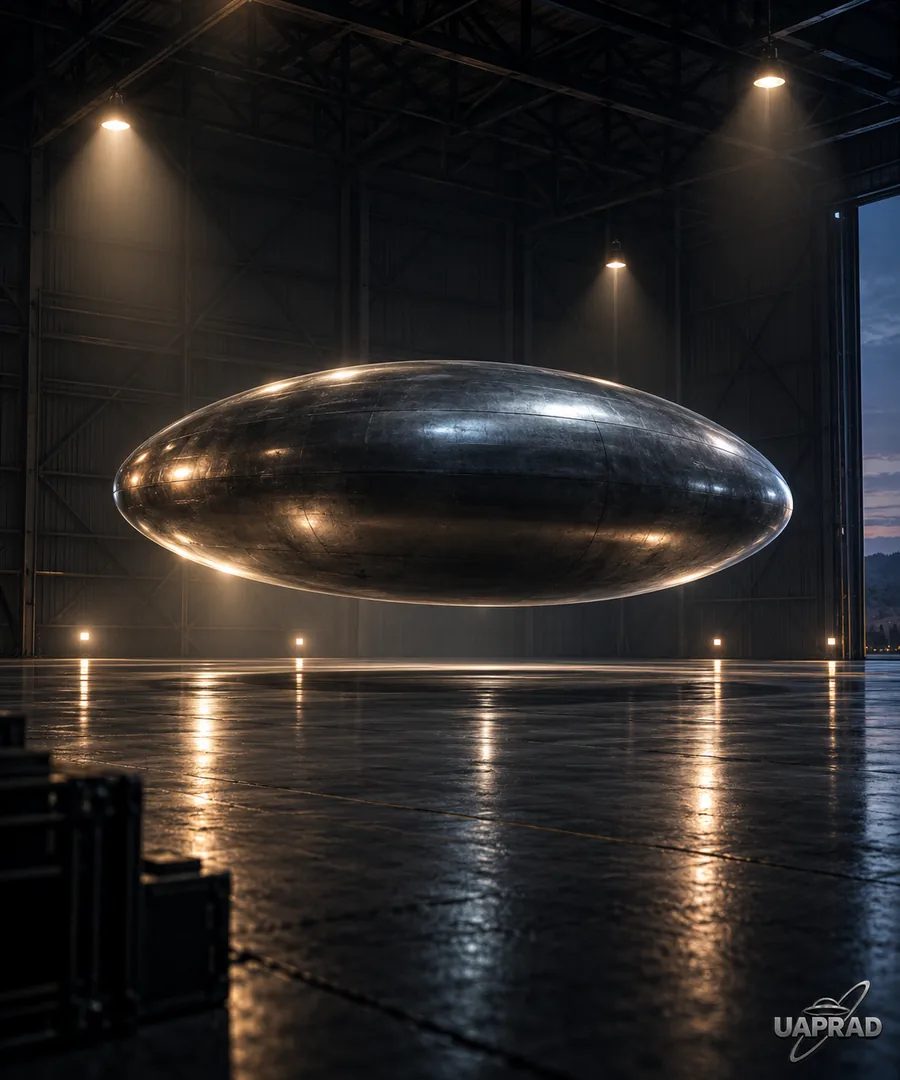
Circular or flattened objects described as discs, saucers or lenticular forms.
discsaucerlenticular form
ChatGPT-generated UAPRAD original.
Overview
Disc and saucer reports describe circular or flattened forms, sometimes with a dome, rim or lenticular profile. The category includes close visual descriptions, ambiguous photographs and distant lights later interpreted as structured objects. It records reported appearance, not a single craft type.
Classification
The catalogue distinguishes a resolved outline from an apparent shape and from roundness created mainly by an image or sensor system. Physical-form confidence then records how far the evidence supports a bounded body rather than a light, contrast area or conventional lookalike.
Reported descriptions
Descriptions range from thin circular plates and lens-like profiles to forms with domes, rims, flat undersides or upper projections. Daylight reports more often describe metallic or silver surfaces; night reports frequently preserve only a bright circular or elliptical image.
A disc assignment therefore has two separate meanings. It may record a witness’s perception of a bounded body, or it may describe the two-dimensional outline produced by a photograph, film frame or unresolved light. The catalogue identifies which evidential class applies to each retained record.
Historical development
The modern label emerged after Kenneth Arnold’s 24 June 1947 report, although Arnold’s best-known saucer analogy concerned motion and his recorded drawings and descriptions do not reduce neatly to a circular disc. Subsequent press coverage made ‘flying saucer’ a general term before it became a stable shape category.
By the early 1950s, official case forms and statistical studies were recording shape alongside colour, duration and motion. Project Blue Book Special Report No. 14 nevertheless found no single verified model across the reports it examined. Later cases extended the label from distant lights and photographs to close visual descriptions and physical-trace investigations, leaving disc morphology historically persistent but evidentially heterogeneous.
Contemporary reporting
AARO’s current public trend table lists 10 reports under ‘Disk’, or 1.7 per cent of reports with morphology data in the displayed period. The aggregate table does not publish the underlying cases or show whether each label came from direct vision, sensor imagery or later coding. It establishes continued use of the category, not a contemporary disc case corpus that can be independently assessed.
Report catalogue
Retained records are classified by the evidence that supports the reported form. Alternate assignments identify genuine overlap; resolved outlines, apparent shapes and sensor-image morphology remain distinct.
11 May 1950 · Near Sheridan, Oregon, United States
McMinnville photographs
Unresolved
Evelyn and Paul Trent reported a slow-moving metallic object above their farm, and Paul made two photographs. The images preserve a distinct asymmetric disc-like outline, but contain no independent scale or range reference. Technical studies divide principally between a distant object and a small suspended model.
Evidence
Sensor-image morphology
Morphology confidence
High
Physical form
Indeterminate
Witnesses
Two civilian witnesses
Evidence profile
F
Asymmetric disc-like image with an upper projection
E
No reported luminosity or exhaust
K
Reported slow transit and tilt
I
None reported
C
Daylight farm observation; range not established
V
Two surviving photographs and witness accounts
R
Original negatives were studied, but scale and provenance remain contested
P
Brief single event
X
One reported object
5 or 15 August 1950 · Great Falls, Montana, United States
Great Falls film
Unresolved
Nick Mariana and his secretary reported two bright objects, and Mariana recorded about 16 seconds of 16 mm film. His early description called them disc-shaped lights, but the surviving film mainly resolves bright sources. The Colorado study found aircraft difficult, though not impossible, to reconcile with the sequence and left the case unexplained.
Evidence
Sensor-image morphology
Morphology confidence
Moderate
Physical form
Indeterminate
Witnesses
Two civilian witnesses
Evidence profile
F
Early report of two disc-shaped lights; film does not securely resolve structure
Daylight observation near an air base; event date is disputed
V
Two witnesses and 16 mm film
R
Substantial formal analysis, with disputed date and missing alleged opening frames
P
At least about 50 seconds visually; 16 seconds on surviving film
X
Two sources maintaining relative position
14 July 1952 · Near Norfolk, Virginia, United States
Nash–Fortenberry sighting
Unresolved
Pan American pilots William Nash and William Fortenberry reported six glowing, disc-shaped objects passing below their DC-4 and reversing their order during a rapid turn. Project Blue Book told Nash in July 1953 that the report remained unsolved. No photograph or radar record fixes range, dimensions or velocity.
Evidence
Apparent morphology
Morphology confidence
Moderate
Physical form
Probable body
Witnesses
Two commercial pilots
Evidence profile
F
Six disc-shaped forms reported edge-on during a turn
E
Red-orange glow, with bright upper surfaces reported
K
Rapid paired formation transit and reported reversal of order
I
None reported
C
Night observation from a DC-4 cockpit
V
Two pilot accounts and Project Blue Book correspondence
R
Named experienced witnesses; no independent range or sensor measurement
P
Short-duration encounter
X
Six reported objects in formation
26–27 June 1959 · Boianai, Papua New Guinea
Father Gill sightings
Unresolved
William Booth Gill and groups of mission witnesses described a large circular or platform-like object with a narrower upper section, apparent legs and figures. Gill made notes and sketches close to the observations and supporting statements were signed, but no image, radar record or physical trace establishes range or structure.
Evidence
Apparent morphology
Morphology confidence
Moderate
Physical form
Probable body
Witnesses
Large civilian witness group
Evidence profile
F
Circular platform with narrower upper section and reported appendages
E
Bright light and reported colour changes
K
Prolonged apparent hovering and movement
I
Reported signalling between observers and figures
C
Repeated evening observations from a mission site
V
Contemporaneous notes, sketches and signed witness statements
R
Large witness group and prompt documentation; no instrumental corroboration
P
Repeated over two principal evenings
X
One principal object with smaller accompanying lights reported
24 April 1964 · Socorro, New Mexico, United States
Socorro incident
Unresolved
Police officer Lonnie Zamora reported a close oval object standing on apparent supports before departing with flame and a loud roar. His immediate reports, sketch and the documented site marks support an oval or compact rounded form more strongly than a classic flattened disc, so this is retained as a cross-category record.
Evidence
Resolved morphology
Morphology confidence
High
Physical form
Resolved body
Witnesses
Police officer
Evidence profile
F
Smooth oval body with apparent supports and a red marking
E
Reported flame, roar and later silence
K
Grounded or near-ground position followed by vertical and horizontal departure
I
Ground impressions and scorched vegetation were documented
C
Daylight close-range police observation
V
Prompt testimony, sketch, scene photographs and official file
R
Strong provenance for the report; one principal direct observer
P
Single short encounter
X
One object and two reported figures
6 April 1966 · Clayton South, Victoria, Australia
Westall school incident
Insufficient data
Students and at least one teacher reported one or more silver, grey or white disc-like objects in daylight. Contemporary reporting and Andrew Greenwood's near-contemporary account establish a significant sighting, but later claims of a landing, trace and official suppression exceed the early documentary record.
Evidence
Apparent morphology
Morphology confidence
Moderate
Physical form
Probable body
Witnesses
Students and school staff
Evidence profile
F
Silver or grey disc-like object reported
E
No stable emission pattern in the early record
K
Movement near light aircraft and departure towards the Grange reported
I
Landing and ground-trace claims are mainly retrospective
C
Daylight school observation with many witnesses
V
Early press and witness accounts; no authenticated imagery
R
Numerous observers, but sparse contemporaneous documentation and later memory convergence
P
Single school-day event
X
Accounts vary between one and multiple objects
20 May 1967 · Near Falcon Lake, Manitoba, Canada
Falcon Lake incident
Unresolved
Stefan Michalak reported two reddish objects, one of which descended nearby and appeared as a metallic disc or oval with an upper dome. Medical records documented burns and illness after the encounter, while Canadian agencies investigated damaged clothing and later site-associated samples. The physical aftermath is documented more securely than its connection to the object because Michalak was the sole direct witness and the site and samples lacked continuous independent custody.
Evidence
Resolved morphology
Morphology confidence
High
Physical form
Probable body
Witnesses
Single civilian witness
Evidence profile
F
Metallic disc or oval with an upper dome and grid-like opening
E
Red appearance, heat and a blast of hot gas or air reported
K
One object remained nearby while the other descended and later departed
I
Documented burns and damaged clothing; radioactive material was later associated with the reported site
C
Daylight close-range wilderness encounter reported by one observer
V
Witness account, medical documentation, clothing, agency files and laboratory results
R
Prompt medical evidence and extensive official follow-up; object observation and later sample provenance depend on the claimant
P
Single encounter with later medical and site investigation
X
Two reported objects, one approached at close range
8 January 1981 · Trans-en-Provence, Var, France
Trans-en-Provence
Unresolved
Renato Nicolai reported a small grey disc-like object with an equatorial band and apparent skids descending onto a terrace before departing. Gendarmes documented a circular ground trace the next day, and GEPAN coordinated soil and vegetation analysis. The prompt official work provides substantial trace evidence, but the object itself rests on a single visual account and ordinary mechanical causes remain relevant to the accessible site.
Evidence
Resolved morphology
Morphology confidence
High
Physical form
Probable body
Witnesses
Single civilian witness
Evidence profile
F
Small grey or zinc-coloured disc with an equatorial band and apparent skids
E
Low whistling sound reported; no sustained luminosity described
K
Descent, brief rest on or near the terrace, then rapid departure
I
Circular striated trace, soil effects and plant changes documented and analysed
C
Late-afternoon close-range observation on private agricultural land
V
Prompt witness statement, gendarmerie photographs, samples and multi-laboratory analysis
R
Strong provenance for the trace investigation; one visual witness and an accessible site
P
Approximately 30 to 40 seconds reported, followed by official investigation
X
One reported object
7 November 2006 · Chicago, Illinois, United States
O’Hare Airport sighting
Insufficient data
United Airlines employees reported a dark, sharply defined disc below low cloud near Gate C17 and described a rapid upward departure. Airline and Federal Aviation Administration communications establish that reports were made, but no authenticated image or public radar track resolves the object. A fallstreak hole is a strong explanation for the reported cloud opening, not necessarily for the preceding disc description.
Evidence
Apparent morphology
Morphology confidence
Moderate
Physical form
Probable body
Witnesses
Multiple aviation employees
Evidence profile
F
Dark disc-like form reported below cloud base
E
No lights or exhaust consistently reported
K
Hovering followed by rapid upward departure reported
I
Circular cloud opening reported after departure
C
Busy airport environment under low overcast
V
Multiple witness accounts and institutional communications; no public sensor record
R
Professional observers and consistent core description; estimates vary and witnesses remain partly anonymous
P
Several minutes reported
X
One reported object
17 August 1958 · Warren, Michigan, United States
Warren daylight report
Unresolved
A civilian observer using field glasses described a bright circular grey-white form with concentric detail. As it rotated and departed, he reported an elongated, centrally raised profile. Project Blue Book left the case unidentified. The changing appearance makes it useful for studying viewing aspect and cross-category assignment, but the single account supplies no measured range or image.
Evidence
Apparent morphology
Morphology confidence
Moderate
Physical form
Probable bounded object
Witnesses
Single civilian witness
Evidence profile
F
Circular or ball-like form changing to an elongated rimmed profile as its aspect changed
E
Bright centre and grey-white outer form; no exhaust reported
K
Initial apparent stationarity followed by rotation, arcing movement and departure
I
None reported
C
Daylight observation with aircraft reportedly passing in the foreground
V
Single witness account using field glasses and an official case file
R
Contemporary file preserves detailed testimony; no photograph, range measurement or second witness
P
Approximately ten minutes reported
X
One reported object
Cases and witnesses
UAPRAD case pages reconstruct the incidents in full. Witness pages preserve the roles and testimony behind the morphology assignment.
McMinnville remains the most structurally distinct image set in the retained corpus. The photographs preserve an asymmetric disc-like outline, yet the lack of an independent range reference permits both a distant-object interpretation and a small-model reconstruction. Image clarity alone does not determine physical scale.
Great Falls and Tremonton are methodologically different. Their films preserve moving bright sources, but the surviving frames do not securely resolve the physical outlines described in later testimony. The Colorado study left Great Falls unexplained while finding Tremonton consistent with birds. Both show why witness form and recorded image form must be assessed separately.
Sensor evidence
No retained disc case combines a resolved outline with independently measured range, calibrated multispectral imagery and corroborating radar. Great Falls and Tremonton provide motion-picture sequences without secure range; McMinnville provides still images with foreground context but no measured object distance; O’Hare has no public sensor record. Radar-only or light-only cases are not added merely because later accounts use saucer language.
Recurring characteristics
The strongest recurrence is descriptive: a broad circular or lenticular outline with few visible aerodynamic surfaces. Surface detail, luminosity, sound and motion vary substantially between records.
Daylight multi-witness reports and photographs provide better morphology evidence than isolated night lights, but neither automatically supplies range or identity. Reports also cross into oval, orb and ring categories when perspective, glare or structural detail is uncertain.
Identification and interpretation
Identification problems
Perspective can compress a circular or cylindrical body into an ellipse and can hide the wings or tail of an aircraft. Without reliable range, an observer cannot derive physical size or speed from angular appearance alone.
Lenticular clouds, balloons, reflections and bright aircraft can present circular or lens-like profiles. Photographs add further possibilities: focus error, motion blur, internal reflection, film damage, suspended models and thrown objects. A conventional analogue is relevant only when its geometry and conditions fit the individual record.
Resolved and explained controls
Controls show how similar appearances can arise without assuming that the same explanation applies to every record.
2 July 1952 · Near Tremonton, Utah, United States
Tremonton film
Plausibly explained
Delbert Newhouse filmed a group of bright sources moving in a clear sky. A later account described paired-saucer profiles, but the early record and film did not resolve metallic structure. The Colorado study found the film consistent with birds and treated the later disc description as less secure than the original account.
Evidence
Sensor-image morphology
Morphology confidence
Low
Physical form
Unresolved light or sensor signature
Witnesses
Family group led by an experienced naval photographer
Evidence profile
F
Bright near-point sources; later saucer description not present in the earliest account
E
Sunlit or self-luminous appearance unresolved
K
Group milling with one source separating
I
None reported
C
Clear daylight sky without range reference
V
Witness accounts and 16 mm film
R
Good camera provenance but weak physical-form resolution
P
Approximately 75 seconds of film
X
Rough group of ten or more sources
Published 1968 · Multiple locations
Disc-like photographic controls
Resolved
The Colorado photographic study reproduced disc-like images with thrown and suspended models and documented lenticular clouds, internal reflections, film damage and balloons as recurrent sources of saucer-like photographs. These controls do not resolve contested cases automatically; they identify tests that a disc image must survive.
Evidence
Sensor-image morphology
Morphology confidence
High
Physical form
Resolved conventional source
Witnesses
Experimental and comparative material
Evidence profile
F
Disc and saucer-like images produced by several unrelated mechanisms
E
Reflected light, glare and exposure effects vary by example
K
Thrown, suspended, drifting or stationary sources
I
None
C
Controlled demonstrations and resolved photographic cases
V
Photographs, geometry and reconstruction
R
Mechanism established for the examples examined
P
Varies
X
Multiple independent controls
Research and analysis
The most useful technical work does not attempt to infer propulsion from outline. It tests image provenance, focus, lighting, camera geometry, angular motion and alternative objects. NASA’s 2023 independent study adds a modern collection standard: calibrated sensors, preserved metadata and multiple measurements are needed before an apparent shape can support reliable physical characterisation.
Conventional objects and effects
Some disc-like reports are balloons, aircraft, clouds, optical effects or fabricated images. Resolved controls establish these mechanisms, but do not identify every superficially similar report.
Unresolved individual events
Several retained cases preserve credible disc-like descriptions or images without enough measurement to choose between all plausible causes. ‘Unresolved’ describes the limit of the record, not a positive identity.
A recurring engineered form
The repeated label has encouraged the hypothesis of a common vehicle design. The corpus does not presently support that step: appearance, evidence class and reported behaviour vary, and no common material or calibrated signature links the cases.
Evidence assessment
The retained record establishes that disc-like forms have been reported by civilian, aviation and police witnesses and have appeared in testimony, photographs, film and physical-trace investigations. Confidence is strongest for the shape recorded in individual close or clearly imaged reports, not for a shared physical class. McMinnville preserves a distinct image but no secure scale; Socorro, Falcon Lake and Trans-en-Provence preserve close structural descriptions but depend on a single principal observer; Great Falls and Tremonton show why a bright image need not resolve a disc. The present evidence supports morphology-led comparison while leaving the identity of the principal unresolved cases open.
Research gaps
Original-generation images, negatives, camera data and full provenance for photographic cases.
Contemporaneous witness statements that preserve shape before media or investigator terminology intervened.
Independent range, angular-size and viewing-angle measurements for future observations.
Synchronous optical, infrared and radar data with calibration and sensor metadata.
Documented conventional controls recorded under the same observing conditions as the report being tested.
Source library
Sources are grouped by evidential role. A tier records provenance and directness; it does not determine whether a reported interpretation is correct.
Tier 1 Primary records and testimony
Kenneth Arnold’s written report and drawing — Arnold’s record is essential to the history of the saucer label, while his drawing and motion description caution against classifying the sighting as a simple circular disc.
Project Blue Book correspondence with William Nash — Pan American pilots William Nash and William Fortenberry reported six glowing, disc-shaped objects passing below their DC-4 and reversing their order during a rapid turn.
Project Blue Book case file: Socorro — Police officer Lonnie Zamora reported a close oval object standing on apparent supports before departing with flame and a loud roar.
Project Blue Book Special Report No. 14 — The report tabulated shape among other characteristics but did not derive a verified common model from the cases studied.
AARO UAP Reporting Trends — AARO’s current table records 10 reports labelled “Disk”; it does not publish case-level morphology evidence.
NASA UAP Independent Study Team final report — The report explains why calibrated sensors, preserved metadata and multiple measurements are needed for reliable physical characterisation.